
Pearson+ LogoPearson+ Logo
Ch.17 Nucleic Acids and Protein Synthesis
Timberlake - Chemistry: An Introduction to General, Organic, and Biological Chemistry 13th Edition
Timberlake13th EditionChemistry: An Introduction to General, Organic, and Biological ChemistryISBN: 9780134421353Not the one you use?Change textbook
Chapter 17, Problem 122(2)

Match each of the following processes (1 to 5) with one of the items (a to e):
2. transcription
a. amino acids are linked together
b. RNA template is used to synthesize DNA
c. helicase unwinds DNA
d. genetic information is transferred from DNA
e. sticky ends join new DNA segment

Verified step by step guidance
1
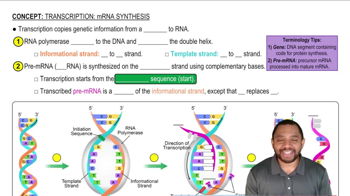
Step 1: Understand the process of transcription. Transcription is the process by which genetic information is transferred from DNA to RNA. This involves the synthesis of messenger RNA (mRNA) using DNA as a template.
Step 2: Analyze the options provided. The correct match for transcription should describe the transfer of genetic information from DNA to RNA.
Step 3: Evaluate each option: (a) refers to amino acids being linked together, which is part of translation, not transcription. (b) refers to RNA being used to synthesize DNA, which is reverse transcription. (c) refers to helicase unwinding DNA, which is part of DNA replication. (d) refers to genetic information being transferred from DNA, which aligns with the definition of transcription. (e) refers to sticky ends joining new DNA segments, which is related to DNA recombination.
Step 4: Based on the analysis, the correct match for transcription is option (d), as it directly describes the process of transferring genetic information from DNA to RNA.
Step 5: Finalize the match: Transcription corresponds to option (d), 'genetic information is transferred from DNA.'

Verified video answer for a similar problem:

This video solution was recommended by our tutors as helpful for the problem above.
Video duration:
3m
Was this helpful?

Key Concepts

Here are the essential concepts you must grasp in order to answer the question correctly.

Transcription

Transcription is the biological process in which the genetic information encoded in DNA is copied into messenger RNA (mRNA). This process occurs in the nucleus of eukaryotic cells and involves the enzyme RNA polymerase, which synthesizes the RNA strand complementary to the DNA template. Transcription is essential for gene expression, as it allows the information in DNA to be translated into proteins.
Recommended video:
Guided course
6:37
Transcription: mRNA Synthesis Concept 1

RNA and DNA Relationship

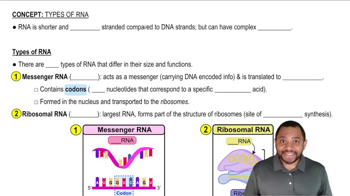
RNA and DNA are both nucleic acids, but they serve different roles in the cell. DNA contains the genetic blueprint for an organism, while RNA acts as a messenger that carries this information from the DNA to the ribosomes, where proteins are synthesized. Understanding this relationship is crucial for grasping how genetic information is expressed and utilized in biological systems.
Recommended video:
Guided course
2:43
Types of RNA Concept 1

Gene Expression

Gene expression is the process by which information from a gene is used to synthesize a functional gene product, typically proteins. This process involves two main stages: transcription, where mRNA is produced from DNA, and translation, where the mRNA is decoded to form a protein. The regulation of gene expression is vital for cellular function and adaptation to environmental changes.
Recommended video:
Guided course
1:30
Introduction to Translation Example 1
Related Practice