Pearson+ LogoPearson+ Logo
Ch.17 Nucleic Acids and Protein Synthesis
Timberlake - Chemistry: An Introduction to General, Organic, and Biological Chemistry 13th Edition
Timberlake13th EditionChemistry: An Introduction to General, Organic, and Biological ChemistryISBN: 9780134421353Not the one you use?Change textbook
Chapter 17, Problem 50

Where does protein synthesis take place?

Verified step by step guidance
1
Understand that protein synthesis is the process by which cells create proteins, which are essential for various biological functions.
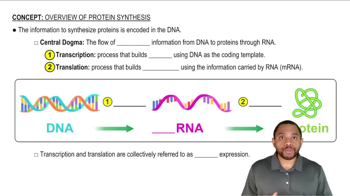
Recognize that protein synthesis occurs in two main stages: transcription and translation.
During transcription, the genetic information in DNA is transcribed into messenger RNA (mRNA) in the nucleus of the cell.
After transcription, the mRNA leaves the nucleus and travels to the ribosomes, which are the cellular structures where translation occurs.
In translation, the ribosomes use the mRNA sequence to assemble amino acids into a specific protein, with the help of transfer RNA (tRNA) and ribosomal RNA (rRNA).

Verified video answer for a similar problem:

This video solution was recommended by our tutors as helpful for the problem above.
Video duration:
2m
Was this helpful?

Key Concepts

Here are the essential concepts you must grasp in order to answer the question correctly.

Protein Synthesis

Protein synthesis is the biological process through which cells generate new proteins. It involves two main stages: transcription, where DNA is converted into messenger RNA (mRNA), and translation, where ribosomes read the mRNA to assemble amino acids into a polypeptide chain, ultimately forming a functional protein.
Recommended video:
Guided course
1:54
Overview of Protein Synthesis Concept 1

Ribosomes

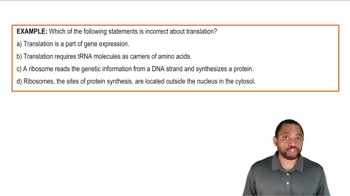
Ribosomes are the cellular structures responsible for translating mRNA into proteins. They can be found either floating freely in the cytoplasm or attached to the endoplasmic reticulum, known as rough ER. Ribosomes facilitate the binding of transfer RNA (tRNA) to mRNA, ensuring the correct sequence of amino acids is assembled.
Recommended video:
Guided course
1:30
Introduction to Translation Example 1

Cellular Locations

Protein synthesis occurs primarily in two locations within the cell: the nucleus and the cytoplasm. Transcription takes place in the nucleus, where DNA is transcribed into mRNA, while translation occurs in the cytoplasm at the ribosomes, where the mRNA is decoded to produce proteins.
Recommended video:
Guided course
1:55
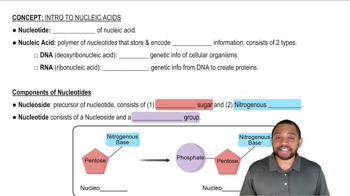
Intro to Nucleic Acids Concept 1