Pearson+ LogoPearson+ Logo
Ch.17 Nucleic Acids and Protein Synthesis
Timberlake - Chemistry: An Introduction to General, Organic, and Biological Chemistry 13th Edition
Timberlake13th EditionChemistry: An Introduction to General, Organic, and Biological ChemistryISBN: 9780134421353Not the one you use?Change textbook
Chapter 17, Problem 51a

Use three-letter and one-letter abbreviations to write the amino acid sequence for the peptide from each of the following mRNA sequences:
a. ACC ACA ACU

Verified step by step guidance
1
Identify the codons in the given mRNA sequence. Codons are groups of three nucleotides. For the sequence 'ACC ACA ACU', the codons are: ACC, ACA, and ACU.
Use the genetic code table to determine the amino acid corresponding to each codon. For example, ACC codes for threonine (Thr), ACA also codes for threonine (Thr), and ACU again codes for threonine (Thr).
Write the amino acid sequence using the three-letter abbreviations. Based on the codons, the sequence is: Thr-Thr-Thr.
Convert the three-letter abbreviations into one-letter abbreviations. For threonine (Thr), the one-letter abbreviation is 'T'. Therefore, the sequence in one-letter abbreviations is: TTT.
Double-check the sequence to ensure that the codons were correctly translated into their corresponding amino acids and that the abbreviations are accurate.

Verified video answer for a similar problem:

This video solution was recommended by our tutors as helpful for the problem above.
Video duration:
1m
Was this helpful?

Key Concepts

Here are the essential concepts you must grasp in order to answer the question correctly.

mRNA Translation

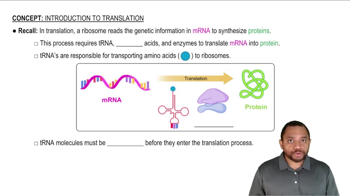
mRNA translation is the process by which ribosomes synthesize proteins based on the sequence of nucleotides in messenger RNA (mRNA). Each set of three nucleotides, known as a codon, corresponds to a specific amino acid. Understanding this process is crucial for determining the amino acid sequence from an mRNA sequence.
Recommended video:
Guided course
1:42
Introduction to Translation Concept 1

Amino Acid Codons

Amino acids are encoded by specific codons in the genetic code, which consists of 64 possible codons derived from the four nucleotides (A, U, C, G). Each codon corresponds to one of the 20 standard amino acids or a stop signal. Familiarity with the codon table is essential for translating mRNA sequences into their respective amino acid sequences.
Recommended video:
Guided course
3:03
Amino Acid Catabolism: Amino Group Example 2

Amino Acid Abbreviations

Amino acids can be represented by one-letter or three-letter abbreviations, which are standardized for ease of communication in biochemistry. For example, alanine is represented as 'A' (one-letter) and 'Ala' (three-letter). Knowing these abbreviations is important for accurately writing and interpreting peptide sequences derived from mRNA.
Recommended video:
Guided course
3:03
Amino Acid Catabolism: Amino Group Example 2