Pearson+ LogoPearson+ Logo
Ch.17 Nucleic Acids and Protein Synthesis
Timberlake - Chemistry: An Introduction to General, Organic, and Biological Chemistry 13th Edition
Timberlake13th EditionChemistry: An Introduction to General, Organic, and Biological ChemistryISBN: 9780134421353Not the one you use?Change textbook
Chapter 17, Problem 49

What are the three steps of translation?

Verified step by step guidance
1
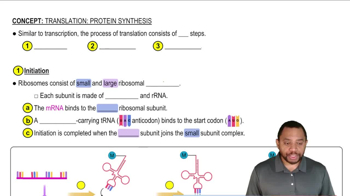
Translation is the process by which the genetic code in mRNA is used to synthesize a protein. The first step is **Initiation**, where the small ribosomal subunit binds to the mRNA at the start codon (AUG), and the initiator tRNA carrying methionine pairs with this codon.
The second step is **Elongation**, where the ribosome moves along the mRNA, and tRNAs bring the appropriate amino acids to the ribosome. Peptide bonds are formed between amino acids, creating a growing polypeptide chain.
The third step is **Termination**, which occurs when the ribosome reaches a stop codon (UAA, UAG, or UGA) on the mRNA. Release factors bind to the ribosome, causing the polypeptide chain to be released and the ribosome to disassemble.

Verified video answer for a similar problem:

This video solution was recommended by our tutors as helpful for the problem above.
Video duration:
5m
Was this helpful?

Key Concepts

Here are the essential concepts you must grasp in order to answer the question correctly.

Transcription

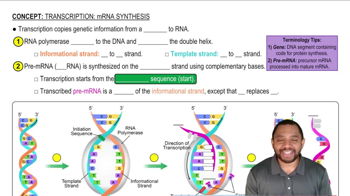
Transcription is the first step of translation, where the DNA sequence of a gene is copied into messenger RNA (mRNA). This process occurs in the nucleus of eukaryotic cells and involves the enzyme RNA polymerase, which synthesizes the mRNA strand complementary to the DNA template. The resulting mRNA carries the genetic information needed for protein synthesis.
Recommended video:
Guided course
6:37
Transcription: mRNA Synthesis Concept 1

Translation Initiation

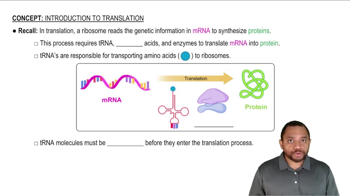
Translation initiation is the second step, where the mRNA binds to the ribosome, the cellular machinery responsible for protein synthesis. During this phase, the small ribosomal subunit recognizes the start codon on the mRNA, and the initiator tRNA, carrying the first amino acid, binds to this codon. This sets the stage for the elongation phase of translation.
Recommended video:
Guided course
1:42
Introduction to Translation Concept 1

Translation Elongation and Termination

The final step involves elongation and termination. During elongation, amino acids are sequentially added to the growing polypeptide chain as the ribosome moves along the mRNA. This process continues until a stop codon is reached, signaling termination, at which point the completed protein is released. This step is crucial for producing functional proteins that perform various roles in the cell.
Recommended video:
Guided course
2:42
Translation: Protein Synthesis Concept 1