Pearson+ LogoPearson+ Logo
Ch.18 Metabolic Pathways and ATP Production
Timberlake - Chemistry: An Introduction to General, Organic, and Biological Chemistry 13th Edition
Timberlake13th EditionChemistry: An Introduction to General, Organic, and Biological ChemistryISBN: 9780134421353Not the one you use?Change textbook
Chapter 18, Problem 11

Where do dietary proteins undergo digestion in the body?

Verified step by step guidance
1
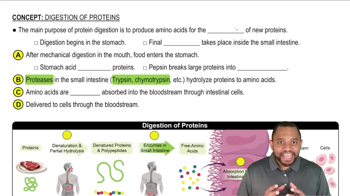
Dietary proteins begin their digestion in the stomach, where the enzyme pepsin is activated by the acidic environment (low pH) created by gastric juices.
Pepsin breaks down proteins into smaller polypeptides by cleaving peptide bonds between amino acids.
The partially digested proteins then move into the small intestine, where pancreatic enzymes such as trypsin and chymotrypsin continue the breakdown of polypeptides into smaller peptides.
In the small intestine, additional enzymes like carboxypeptidase and aminopeptidase further hydrolyze peptides into individual amino acids.
The resulting amino acids are absorbed through the intestinal lining into the bloodstream, where they are transported to cells for use in various biological processes.

Verified video answer for a similar problem:

This video solution was recommended by our tutors as helpful for the problem above.
Video duration:
1m
Was this helpful?

Key Concepts

Here are the essential concepts you must grasp in order to answer the question correctly.

Protein Digestion

Protein digestion is the biochemical process by which proteins are broken down into smaller peptides and amino acids. This process begins in the stomach, where gastric juices denature proteins and activate pepsin, an enzyme that starts protein breakdown. The digestion continues in the small intestine, where pancreatic enzymes further hydrolyze peptides into amino acids for absorption.
Recommended video:
Guided course
2:01
Digestion of Proteins Concept 1

Digestive System Organs

The digestive system consists of various organs that play specific roles in the digestion and absorption of nutrients. Key organs involved in protein digestion include the stomach, where initial breakdown occurs, and the small intestine, where most digestion and absorption take place. The pancreas also contributes by secreting enzymes that aid in the digestion of proteins.
Recommended video:
Guided course
2:01
Digestion of Proteins Concept 1

Absorption of Amino Acids

After proteins are digested into amino acids, these building blocks are absorbed primarily in the small intestine. The intestinal lining contains specialized transporters that facilitate the uptake of amino acids into the bloodstream. Once absorbed, amino acids are transported to various tissues in the body, where they are utilized for protein synthesis and other metabolic functions.
Recommended video:
Guided course
3:03
Amino Acid Catabolism: Amino Group Example 2