Pearson+ LogoPearson+ Logo
Ch.18 Metabolic Pathways and ATP Production
Timberlake - Chemistry: An Introduction to General, Organic, and Biological Chemistry 13th Edition
Timberlake13th EditionChemistry: An Introduction to General, Organic, and Biological ChemistryISBN: 9780134421353Not the one you use?Change textbook
Chapter 18, Problem 10

How are insoluble triacylglycerols transported to the cells?

Verified step by step guidance
1
Understand that triacylglycerols are a type of lipid, which are hydrophobic and insoluble in water. This means they cannot freely dissolve in the bloodstream, which is primarily water-based.
Learn that the body uses lipoproteins to transport insoluble lipids like triacylglycerols. Lipoproteins are complexes made of lipids and proteins that allow hydrophobic molecules to be carried in the aqueous environment of the blood.
Recognize that triacylglycerols are packaged into lipoproteins, such as chylomicrons and very-low-density lipoproteins (VLDLs). These lipoproteins have a hydrophilic outer layer made of proteins and phospholipids, which interact with water, and a hydrophobic core that contains triacylglycerols and other lipids.
Understand that chylomicrons transport dietary triacylglycerols from the intestines to tissues, while VLDLs transport triacylglycerols synthesized in the liver to various cells in the body.
Learn that once the lipoproteins reach the target cells, enzymes like lipoprotein lipase break down the triacylglycerols into glycerol and free fatty acids, which can then be absorbed by the cells and used for energy or stored for later use.

Verified video answer for a similar problem:

This video solution was recommended by our tutors as helpful for the problem above.
Video duration:
1m
Was this helpful?

Key Concepts

Here are the essential concepts you must grasp in order to answer the question correctly.

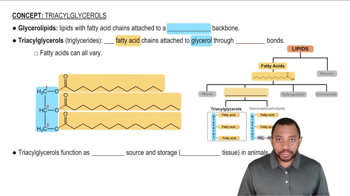
Triacylglycerols

Triacylglycerols, also known as triglycerides, are a type of fat found in the body and in food. They consist of three fatty acid molecules esterified to a glycerol backbone. Due to their hydrophobic nature, they are insoluble in water, which necessitates specific transport mechanisms in the bloodstream to reach cells for energy or storage.
Recommended video:
Guided course
1:52
Triacylglycerols Concept 1

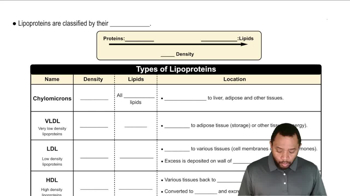
Lipoproteins

Lipoproteins are complex particles composed of lipids and proteins that facilitate the transport of insoluble fats, like triacylglycerols, in the aqueous environment of the bloodstream. They vary in density and composition, with chylomicrons and very low-density lipoproteins (VLDL) being key players in transporting dietary and endogenous triacylglycerols to tissues.
Recommended video:
Guided course
3:52
Lipoproteins for Transport Concept 2

Cellular Uptake Mechanisms

Cells utilize specific mechanisms to uptake triacylglycerols, primarily through the action of lipoprotein lipase, an enzyme that hydrolyzes triacylglycerols into free fatty acids and glycerol. These products can then be absorbed by cells via fatty acid transport proteins, allowing for their utilization in energy production or storage.
Recommended video:
Guided course
2:54
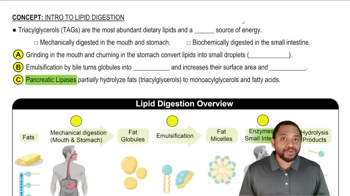
Intro to Lipid Digestion Concept 1