Pearson+ LogoPearson+ Logo
Ch.18 Metabolic Pathways and ATP Production
Timberlake - Chemistry: An Introduction to General, Organic, and Biological Chemistry 13th Edition
Timberlake13th EditionChemistry: An Introduction to General, Organic, and Biological ChemistryISBN: 9780134421353Not the one you use?Change textbook
Chapter 18, Problem 13a

Identify one or more coenzymes with each of the following components:
a. pantothenic acid

Verified step by step guidance
1
Understand the term 'coenzyme': A coenzyme is a non-protein organic molecule that binds to an enzyme and assists in catalyzing a reaction. Coenzymes often derive from vitamins.
Recognize that pantothenic acid is a B-vitamin (Vitamin B5) and serves as a precursor for the synthesis of coenzymes.
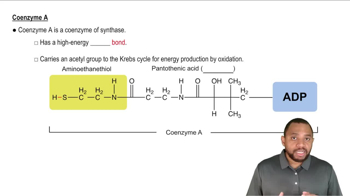
Recall that pantothenic acid is a key component of coenzyme A (CoA), which plays a critical role in metabolic pathways such as the citric acid cycle and fatty acid metabolism.
Note that coenzyme A contains pantothenic acid as part of its structure, along with other components like adenosine diphosphate (ADP) and a thiol group (-SH) that is essential for its function.
Conclude that the coenzyme associated with pantothenic acid is coenzyme A (CoA), which is vital for acyl group transfer reactions in metabolism.

Verified video answer for a similar problem:

This video solution was recommended by our tutors as helpful for the problem above.
Video duration:
1m
Was this helpful?

Key Concepts

Here are the essential concepts you must grasp in order to answer the question correctly.

Coenzymes

Coenzymes are organic molecules that assist enzymes in catalyzing biochemical reactions. They often act as carriers for chemical groups or electrons, facilitating the transfer of these components during metabolic processes. Coenzymes are essential for the proper functioning of enzymes, and their absence can lead to metabolic dysfunction.
Recommended video:
Guided course
1:02
Coenzyme A Concept 4

Pantothenic Acid

Pantothenic acid, also known as vitamin B5, is a water-soluble vitamin that is crucial for synthesizing coenzyme A (CoA). CoA plays a vital role in fatty acid metabolism and the synthesis of acetylcholine, a neurotransmitter. It is found in various foods, including meats, whole grains, and legumes, highlighting its importance in a balanced diet.
Recommended video:

Coenzyme A (CoA)

Coenzyme A (CoA) is a key coenzyme derived from pantothenic acid that is involved in the metabolism of fatty acids and carbohydrates. It serves as a carrier of acyl groups, facilitating their transfer in metabolic pathways such as the citric acid cycle and fatty acid synthesis. CoA is essential for energy production and the synthesis of various biomolecules.
Recommended video:
Guided course
1:10
Coenzyme A Example 4