Pearson+ LogoPearson+ Logo
Ch.18 Metabolic Pathways and ATP Production
Timberlake - Chemistry: An Introduction to General, Organic, and Biological Chemistry 13th Edition
Timberlake13th EditionChemistry: An Introduction to General, Organic, and Biological ChemistryISBN: 9780134421353Not the one you use?Change textbook
Chapter 18, Problem 18.5

Why is ATP considered an energy-rich compound?

Verified step by step guidance
1
Understand that ATP (adenosine triphosphate) is a molecule that stores and transfers energy within cells.
Recognize that ATP contains three phosphate groups, and the bonds between these phosphate groups are high-energy bonds.
Note that when ATP is hydrolyzed (reacts with water), it loses one phosphate group to form ADP (adenosine diphosphate) and an inorganic phosphate (Pi), releasing energy in the process.
Realize that the energy released during the hydrolysis of ATP is used by cells to perform various functions, such as muscle contraction, active transport, and biosynthesis.
Understand that the high energy of ATP is due to the repulsion between the closely packed, negatively charged phosphate groups, which makes the molecule unstable and ready to release energy when the bond is broken.

Verified video answer for a similar problem:

This video solution was recommended by our tutors as helpful for the problem above.
Video duration:
1m
Was this helpful?

Key Concepts

Here are the essential concepts you must grasp in order to answer the question correctly.

Adenosine Triphosphate (ATP)

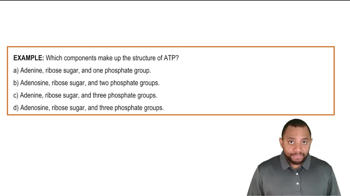
ATP, or adenosine triphosphate, is a nucleotide that serves as the primary energy carrier in all living organisms. It consists of an adenosine molecule bonded to three phosphate groups. The high-energy bonds between these phosphate groups store energy that can be released when the bonds are broken, making ATP crucial for various cellular processes.
Recommended video:
Guided course
1:03
Adenosine Triphosphate (ATP) Example 2

High-Energy Phosphate Bonds

The energy-rich nature of ATP is largely due to its high-energy phosphate bonds, particularly the bonds between the second and third phosphate groups. When ATP is hydrolyzed to ADP (adenosine diphosphate) and an inorganic phosphate, a significant amount of energy is released, which can be harnessed for biochemical reactions, muscle contraction, and other cellular activities.
Recommended video:

Role in Metabolism

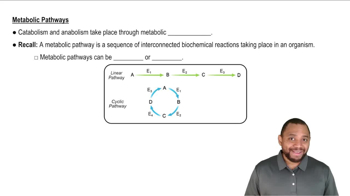
ATP plays a central role in metabolism by acting as a universal energy currency. It is involved in both catabolic and anabolic reactions, facilitating the transfer of energy from energy-releasing processes (like cellular respiration) to energy-consuming processes (like biosynthesis). This versatility makes ATP essential for maintaining cellular functions and overall energy balance in organisms.
Recommended video:
Guided course
0:52
Metabolic Pathways Concept 2