Pearson+ LogoPearson+ Logo
Ch.2 Chemistry and Measurements
Timberlake - Chemistry: An Introduction to General, Organic, and Biological Chemistry 13th Edition
Timberlake13th EditionChemistry: An Introduction to General, Organic, and Biological ChemistryISBN: 9780134421353Not the one you use?Change textbook
Chapter 2, Problem 88b

A shipping box has a length of 7.00 in., a width of 6.00 in., and a height of 4.00 in.
<IMAGE>
b. What is the width of the box, in centimeters?

Verified step by step guidance
1
Step 1: Identify the width of the box in inches from the problem statement. The width is given as 6.00 inches.
Step 2: Recall the conversion factor between inches and centimeters. 1 inch is equal to 2.54 centimeters.
Step 3: Multiply the width in inches by the conversion factor to convert it to centimeters. Use the formula: \( \text{Width in cm} = \text{Width in inches} \times 2.54 \).
Step 4: Perform the multiplication to find the width in centimeters. Ensure proper unit cancellation during the calculation.
Step 5: The result will give the width of the box in centimeters. Double-check the calculation for accuracy.

Verified video answer for a similar problem:

This video solution was recommended by our tutors as helpful for the problem above.
Video duration:
1m
Was this helpful?

Key Concepts

Here are the essential concepts you must grasp in order to answer the question correctly.

Volume and Dimensions of a Box

The volume of a box is calculated using its dimensions: length, width, and height. For a rectangular box, the formula is Volume = Length × Width × Height. Understanding these dimensions is crucial for solving problems related to the box's capacity or converting measurements.
Recommended video:

Unit Conversion

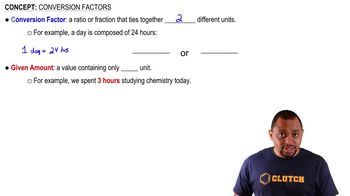
Unit conversion is the process of converting a measurement from one unit to another, such as inches to centimeters. In this case, 1 inch is equivalent to 2.54 centimeters. Mastery of unit conversion is essential for accurately interpreting and solving problems that involve different measurement systems.
Recommended video:
Guided course
01:56
Conversion Factors (Simplified) Concept 1

Measurement Systems

Measurement systems, such as the Imperial system (inches) and the Metric system (centimeters), are used globally for various applications. Understanding the differences between these systems is important for ensuring accurate calculations and comparisons, especially in fields like shipping and logistics.
Recommended video:
Guided course
02:52
Measuring Radioactivity Concept 1