Pearson+ LogoPearson+ Logo
Ch.2 Chemistry and Measurements
Timberlake - Chemistry: An Introduction to General, Organic, and Biological Chemistry 13th Edition
Timberlake13th EditionChemistry: An Introduction to General, Organic, and Biological ChemistryISBN: 9780134421353Not the one you use?Change textbook
Chapter 2, Problem 43

Why can two conversion factors be written for an equality such as 1 m = 100 cm?

Verified step by step guidance
1
Understand the concept of an equality: An equality is a statement that shows two quantities are equivalent, such as 1 meter (m) = 100 centimeters (cm). This means that 1 meter contains the same length as 100 centimeters.
Recognize the purpose of conversion factors: Conversion factors are ratios derived from equalities that allow us to convert between units. They are written as fractions where the numerator and denominator represent equivalent quantities in different units.
Write the first conversion factor: From the equality 1 m = 100 cm, we can write the conversion factor as \( \frac{1 \text{ m}}{100 \text{ cm}} \). This factor is used to convert centimeters to meters.
Write the second conversion factor: The equality can also be expressed in reverse, \( \frac{100 \text{ cm}}{1 \text{ m}} \). This factor is used to convert meters to centimeters.
Understand why two factors are possible: The equality represents a relationship that works in both directions. Depending on whether you are converting from meters to centimeters or centimeters to meters, you use the appropriate conversion factor.

Verified video answer for a similar problem:

This video solution was recommended by our tutors as helpful for the problem above.
Video duration:
37s
Was this helpful?

Key Concepts

Here are the essential concepts you must grasp in order to answer the question correctly.

Conversion Factor

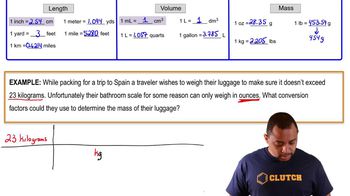
A conversion factor is a numerical multiplier used to convert a quantity from one unit to another. It is derived from an equality between two different units, allowing for the expression of the same quantity in different terms. For example, the equality 1 m = 100 cm can be expressed as two conversion factors: 100 cm/1 m and 1 m/100 cm.
Recommended video:
Guided course
03:45
Conversion Factors (Simplified) Example 2

Unit Equality

Unit equality refers to the relationship between two different units that measure the same quantity. In the case of 1 m = 100 cm, this equality indicates that one meter is equivalent to one hundred centimeters. Understanding unit equality is essential for creating accurate conversion factors and ensuring that measurements are consistent across different unit systems.
Recommended video:
Guided course
01:15
Pressure Units Concept 1

Dimensional Analysis

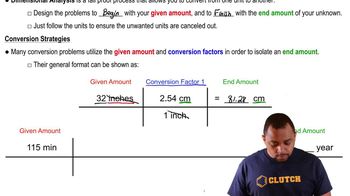
Dimensional analysis is a mathematical technique used to convert between units by utilizing conversion factors. It involves multiplying a quantity by one or more conversion factors to change its unit while maintaining its value. This method is crucial for solving problems in physics and chemistry, where different units are often used, ensuring that calculations yield correct and meaningful results.
Recommended video:
Guided course
06:11
Dimensional Analysis