Pearson+ LogoPearson+ Logo
Ch.3 Matter and Energy
Timberlake - Chemistry: An Introduction to General, Organic, and Biological Chemistry 13th Edition
Timberlake13th EditionChemistry: An Introduction to General, Organic, and Biological ChemistryISBN: 9780134421353Not the one you use?Change textbook
Chapter 3, Problem 89

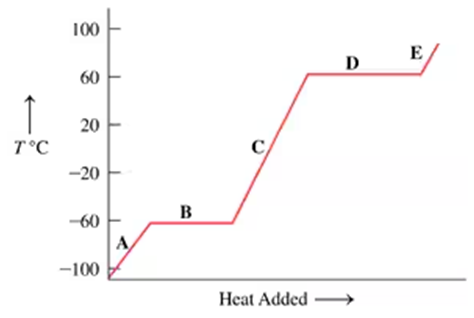
The following graph is a heating curve for chloroform, a solvent for fats, oils, and waxes:
d. At the following temperatures, is chloroform a solid, liquid, or gas?
–80 °C, –40 °C; 25 °C; 80 °C

Verified step by step guidance
1
Step 1: Analyze the heating curve provided in the graph. The graph shows temperature changes as heat is added to chloroform. Flat regions indicate phase changes (melting or boiling), while sloped regions indicate temperature increases within a single phase.
Step 2: Identify the phase transition points. From the graph, the flat region near -100 °C corresponds to the melting point (solid to liquid transition), and the flat region near 60 °C corresponds to the boiling point (liquid to gas transition).
Step 3: Determine the phase of chloroform at -80 °C. Since -80 °C is above the melting point (-100 °C) but below the boiling point (60 °C), chloroform is in the liquid phase.
Step 4: Determine the phase of chloroform at -40 °C. Similar to -80 °C, -40 °C is also above the melting point and below the boiling point, so chloroform is in the liquid phase.
Step 5: Determine the phase of chloroform at 25 °C and 80 °C. At 25 °C, chloroform is still in the liquid phase because it is below the boiling point. At 80 °C, chloroform is in the gas phase because it is above the boiling point.

Verified video answer for a similar problem:

This video solution was recommended by our tutors as helpful for the problem above.
Video duration:
1m
Was this helpful?

Key Concepts

Here are the essential concepts you must grasp in order to answer the question correctly.

Heating Curve

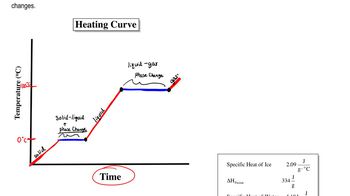
A heating curve is a graphical representation that shows the change in temperature of a substance as heat is added over time. It illustrates phase changes, such as melting and boiling, where temperature remains constant despite heat input. Understanding the heating curve is essential for determining the state of a substance at various temperatures.
Recommended video:
Guided course
09:03
Heating and Cooling Curves Concept 1

Phase Changes

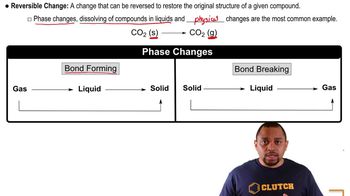
Phase changes refer to the transitions between solid, liquid, and gas states of matter. For chloroform, these changes occur at specific temperatures: it solidifies below its freezing point, melts at its melting point, and vaporizes at its boiling point. Recognizing these temperature thresholds is crucial for identifying the state of chloroform at given temperatures.
Recommended video:
Guided course
03:40
Physical & Chemical Changes

Chloroform Properties

Chloroform is a chemical compound with distinct physical properties, including a freezing point of approximately -63.5 °C and a boiling point of about 61.2 °C. These properties dictate its behavior under varying temperature conditions. Knowing these values helps in determining whether chloroform is solid, liquid, or gas at specific temperatures.
Recommended video:
Guided course
02:11
Chemical Properties Example 1