Pearson+ LogoPearson+ Logo
Ch.3 Matter and Energy
Timberlake - Chemistry: An Introduction to General, Organic, and Biological Chemistry 13th Edition
Timberlake13th EditionChemistry: An Introduction to General, Organic, and Biological ChemistryISBN: 9780134421353Not the one you use?Change textbook
Chapter 3, Problem 97

When a 0.66-g sample of olive oil is burned in a calorimeter, the heat released increases the temperature of 370 g of water from 22.7 °C to 38.8 °C. What is the energy value for the olive oil in kcal/g?

Verified step by step guidance
1
Determine the heat absorbed by the water using the formula: Q = m imes c imes ΔT, where m is the mass of water (370 g), c is the specific heat capacity of water (1.00 cal/g·°C), and ΔT is the change in temperature (final temperature - initial temperature).
Calculate the temperature change, ΔT, by subtracting the initial temperature (22.7 °C) from the final temperature (38.8 °C).
Substitute the values for m, c, and ΔT into the formula to calculate the heat absorbed by the water, Q, in calories.
Convert the heat absorbed by the water from calories to kilocalories by dividing the result by 1000 (since 1 kcal = 1000 cal).
Determine the energy value of the olive oil in kcal/g by dividing the total heat released (in kcal) by the mass of the olive oil sample (0.66 g).

Verified video answer for a similar problem:

This video solution was recommended by our tutors as helpful for the problem above.
Video duration:
4m
Was this helpful?

Key Concepts

Here are the essential concepts you must grasp in order to answer the question correctly.

Calorimetry

Calorimetry is the science of measuring the heat of chemical reactions or physical changes. In this context, it involves using a calorimeter to determine the amount of heat released when a substance, like olive oil, is burned. The heat transfer to the surrounding water allows us to calculate the energy content of the substance based on the temperature change observed.

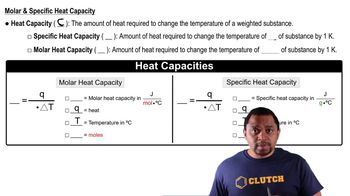
Specific Heat Capacity

Specific heat capacity is the amount of heat required to raise the temperature of a unit mass of a substance by one degree Celsius. For water, this value is typically 4.18 J/g°C. Understanding specific heat capacity is crucial for calculating the energy absorbed by the water in the calorimeter, which directly relates to the energy released by the burning olive oil.
Recommended video:
Guided course
02:19
Heat Capacity

Energy Value Calculation

The energy value of a substance, often expressed in kcal/g, quantifies the amount of energy released per gram when the substance is combusted. To find this value for olive oil, one must calculate the total heat absorbed by the water and then divide it by the mass of the olive oil sample. This calculation provides insight into the caloric content of the oil, which is important for nutritional assessments.
Recommended video: