Pearson+ LogoPearson+ Logo
Ch.3 Matter and Energy
Timberlake - Chemistry: An Introduction to General, Organic, and Biological Chemistry 13th Edition
Timberlake13th EditionChemistry: An Introduction to General, Organic, and Biological ChemistryISBN: 9780134421353Not the one you use?Change textbook
Chapter 3, Problem 87

On a hot day, the beach sand gets hot but the water stays cool. Would you predict that the specific heat of sand is higher or lower than that of water? Explain.
<IMAGE>

Verified step by step guidance
1
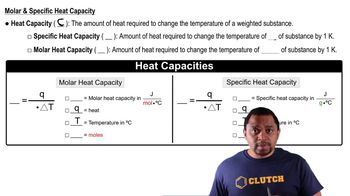
Understand the concept of specific heat: Specific heat is the amount of heat energy required to raise the temperature of 1 gram of a substance by 1°C. Substances with a high specific heat require more energy to change their temperature, while substances with a low specific heat require less energy.
Analyze the scenario: On a hot day, the sand heats up quickly, while the water remains relatively cool. This indicates that the sand's temperature changes more rapidly than the water's temperature when exposed to the same amount of heat energy.
Relate the observation to specific heat: A substance that heats up quickly with less energy input has a lower specific heat. Conversely, a substance that resists temperature change and stays cool has a higher specific heat.
Apply the concept to the problem: Since the sand heats up quickly, it must have a lower specific heat compared to water. Water, which remains cool, has a higher specific heat, meaning it requires more energy to increase its temperature.
Conclude the prediction: Based on the observations and the concept of specific heat, the specific heat of sand is lower than that of water.

Verified video answer for a similar problem:

This video solution was recommended by our tutors as helpful for the problem above.
Video duration:
3m
Was this helpful?

Key Concepts

Here are the essential concepts you must grasp in order to answer the question correctly.

Specific Heat Capacity

Specific heat capacity is the amount of heat energy required to raise the temperature of a unit mass of a substance by one degree Celsius. It is a crucial property that determines how substances respond to heat. Materials with high specific heat can absorb more heat without a significant change in temperature, while those with low specific heat heat up quickly.
Recommended video:
Guided course
02:19
Heat Capacity

Thermal Conductivity

Thermal conductivity refers to a material's ability to conduct heat. It influences how quickly heat is transferred through a substance. In the context of sand and water, sand has lower thermal conductivity compared to water, which means it heats up faster when exposed to sunlight, while water remains cooler due to its higher specific heat capacity.
Recommended video:
Guided course
02:13
Thermal Equilibrium (Simplified) Concept 1

Heat Transfer

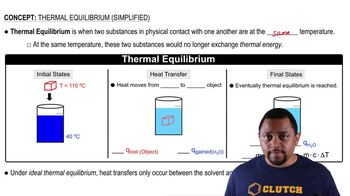
Heat transfer is the process of thermal energy moving from one object or substance to another. It occurs through conduction, convection, or radiation. On a hot day, the sun heats the sand directly, causing it to reach higher temperatures quickly, while the water, with its higher specific heat, absorbs heat more slowly, resulting in a cooler temperature.
Recommended video:
Guided course
02:19
Heat Capacity