Pearson+ LogoPearson+ Logo
Ch.3 Matter and Energy
Timberlake - Chemistry: An Introduction to General, Organic, and Biological Chemistry 13th Edition
Timberlake13th EditionChemistry: An Introduction to General, Organic, and Biological ChemistryISBN: 9780134421353Not the one you use?Change textbook
Chapter 3, Problem 99a

In a large building, oil is used in a steam boiler heating system. The combustion of 1.0 lb of oil provides 2.4 × 10⁷ J.
a. How many kilograms of oil are needed to heat 150 kg of water from 22 °C to 100 °C?

Verified step by step guidance
1
Step 1: Calculate the heat required to heat the water. Use the formula for heat transfer: Q = m × c × ΔT, where Q is the heat energy, m is the mass of water (150 kg), c is the specific heat capacity of water (4.184 J/g°C or 4184 J/kg°C), and ΔT is the temperature change (100 °C - 22 °C).
Step 2: Convert the heat energy required (Q) from Step 1 into the amount of energy in joules.
Step 3: Determine how much energy is provided by 1 kilogram of oil. First, convert the energy provided by 1.0 lb of oil (2.4 × 10⁷ J) into energy per kilogram. Use the conversion factor: 1 lb = 0.453592 kg.
Step 4: Calculate the mass of oil required. Divide the total heat energy required (Q) by the energy provided per kilogram of oil (from Step 3).
Step 5: Verify the units and ensure the final answer is in kilograms of oil. Double-check all calculations for consistency and accuracy.

Verified video answer for a similar problem:

This video solution was recommended by our tutors as helpful for the problem above.
Video duration:
3m
Was this helpful?

Key Concepts

Here are the essential concepts you must grasp in order to answer the question correctly.

Specific Heat Capacity

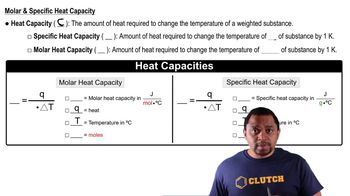
Specific heat capacity is the amount of heat required to raise the temperature of a unit mass of a substance by one degree Celsius. For water, this value is approximately 4.18 J/g°C. Understanding this concept is crucial for calculating the energy needed to heat water, as it directly relates the mass of the water and the temperature change to the total energy required.
Recommended video:
Guided course
02:19
Heat Capacity

Energy Conservation

The principle of energy conservation states that energy cannot be created or destroyed, only transformed from one form to another. In this context, the energy produced by burning oil is converted into thermal energy to heat the water. This concept is essential for determining how much oil is needed based on the energy required to heat the water.
Recommended video:
Guided course
01:48
Law of Conservation of Mass

Conversion of Units

Conversion of units is the process of changing a quantity expressed in one set of units to another. In this problem, it is necessary to convert pounds of oil to kilograms and joules to the appropriate units for energy calculations. Mastery of unit conversion is vital for ensuring that all measurements are compatible and accurate in the calculations.
Recommended video:
Guided course
01:56
Conversion Factors (Simplified) Concept 1