Pearson+ LogoPearson+ Logo
Ch.5 Nuclear Chemistry
Timberlake - Chemistry: An Introduction to General, Organic, and Biological Chemistry 13th Edition
Timberlake13th EditionChemistry: An Introduction to General, Organic, and Biological ChemistryISBN: 9780134421353Not the one you use?Change textbook
Chapter 5, Problem 2b

Identify the type of particle or radiation for each of the following:
b. 11H

Verified step by step guidance
1
Step 1: Understand the notation ¹₁H. The superscript (¹) represents the mass number, which is the total number of protons and neutrons in the nucleus. The subscript (₁) represents the atomic number, which is the number of protons in the nucleus.
Step 2: Recognize that the atomic number (₁) corresponds to the element hydrogen (H) on the periodic table. This means the particle is a form of hydrogen.
Step 3: Determine the number of neutrons in the nucleus. Subtract the atomic number (₁) from the mass number (¹): Mass number - Atomic number = 1 - 1 = 0 neutrons.
Step 4: Conclude that this particle is a hydrogen nucleus with no neutrons, which is also known as a proton. This is because a hydrogen atom with no neutrons is essentially a single proton.
Step 5: Identify the type of particle as a proton, which is a positively charged subatomic particle commonly found in the nucleus of atoms.

Verified video answer for a similar problem:

This video solution was recommended by our tutors as helpful for the problem above.
Video duration:
2m
Was this helpful?

Key Concepts

Here are the essential concepts you must grasp in order to answer the question correctly.

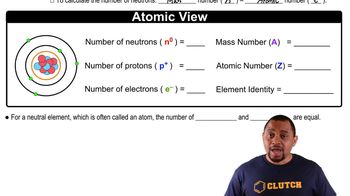
Hydrogen Isotope

¹₁H, also known as protium, is the most common isotope of hydrogen, consisting of one proton and no neutrons. It is a stable particle and is often used in various scientific applications, including nuclear magnetic resonance (NMR) spectroscopy. Understanding isotopes is crucial for distinguishing between different forms of an element based on their nuclear composition.
Recommended video:

Nuclear Notation

Nuclear notation is a way of representing atomic nuclei using the element's symbol along with its atomic number and mass number. In the case of ¹₁H, the '1' represents the mass number (total protons and neutrons), while the subscript '1' indicates the atomic number (number of protons). This notation helps in identifying the specific isotope and its properties.
Recommended video:
Guided course
01:41
Scientific Notation

Types of Radiation

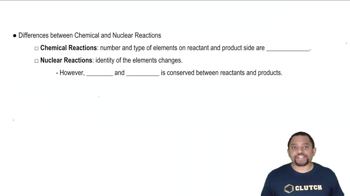
Particles like ¹₁H can be involved in various types of radiation, including alpha, beta, and gamma radiation. However, ¹₁H itself is not a form of radiation but rather a stable particle. Understanding the distinction between particles and radiation types is essential for analyzing nuclear reactions and their implications in fields like nuclear physics and chemistry.
Recommended video:
Guided course
03:27
Types of Radiation Concept 2