Pearson+ LogoPearson+ Logo
Ch.6 Ionic and Molecular Compounds
Timberlake - Chemistry: An Introduction to General, Organic, and Biological Chemistry 13th Edition
Timberlake13th EditionChemistry: An Introduction to General, Organic, and Biological ChemistryISBN: 9780134421353Not the one you use?Change textbook
Chapter 6, Problem 86b

Identify the major type of intermolecular forces between the particles of each of the following:
b. MgF2

Verified step by step guidance
1
Identify the type of compound: MgF₂ is an ionic compound because it consists of a metal (Mg) and a nonmetal (F). Ionic compounds are held together by strong electrostatic forces between oppositely charged ions.
Understand the nature of the intermolecular forces: In ionic compounds like MgF₂, the primary intermolecular force is ionic bonding, which is the attraction between positively charged cations (Mg²⁺) and negatively charged anions (F⁻).
Consider the lattice structure: MgF₂ forms a crystalline lattice where each Mg²⁺ ion is surrounded by F⁻ ions, and vice versa. This arrangement maximizes the ionic interactions and contributes to the compound's high melting and boiling points.
Compare with other types of intermolecular forces: Ionic bonds are much stronger than other types of intermolecular forces, such as hydrogen bonding, dipole-dipole interactions, or London dispersion forces, which are typically found in covalent compounds.
Conclude the major intermolecular force: The major type of intermolecular force in MgF₂ is ionic bonding, which dominates due to the nature of the ionic compound.

Verified video answer for a similar problem:

This video solution was recommended by our tutors as helpful for the problem above.
Video duration:
1m
Was this helpful?

Key Concepts

Here are the essential concepts you must grasp in order to answer the question correctly.

Ionic Bonds

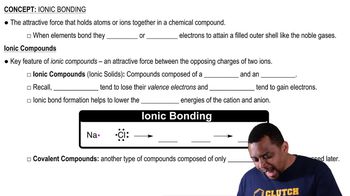
Ionic bonds are formed through the electrostatic attraction between positively and negatively charged ions. In the case of MgF₂, magnesium (Mg) donates two electrons to become Mg²⁺, while each fluorine (F) atom gains one electron to become F⁻. This transfer of electrons results in a strong ionic bond, which is a key characteristic of ionic compounds.
Recommended video:
Guided course
02:33
Ionic Bonding Concept 1

Intermolecular Forces

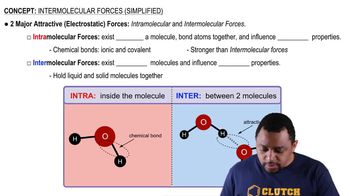
Intermolecular forces are the forces of attraction or repulsion between neighboring particles (atoms, molecules, or ions). In ionic compounds like MgF₂, the primary intermolecular forces are ionic interactions, which are significantly stronger than other types of intermolecular forces such as hydrogen bonds or van der Waals forces. These strong forces contribute to the high melting and boiling points of ionic compounds.
Recommended video:
Guided course
01:59
Intermolecular Forces (Simplified) Concept 1

Lattice Structure

The lattice structure refers to the organized, repeating arrangement of ions in an ionic compound. In MgF₂, the Mg²⁺ and F⁻ ions are arranged in a three-dimensional lattice, maximizing the attractive forces between oppositely charged ions while minimizing repulsion between like charges. This structure is crucial for the stability and properties of ionic compounds, including their hardness and brittleness.
Recommended video:
Guided course
1:01
Structural Formula Concept 2