Pearson+ LogoPearson+ Logo
Ch.6 Ionic and Molecular Compounds
Timberlake - Chemistry: An Introduction to General, Organic, and Biological Chemistry 13th Edition
Timberlake13th EditionChemistry: An Introduction to General, Organic, and Biological ChemistryISBN: 9780134421353Not the one you use?Change textbook
Chapter 6, Problem 80

Why is CCl4 a nonpolar molecule, but is PCl3 a polar molecule?

Verified step by step guidance
1
Step 1: Understand the concept of molecular polarity. A molecule is polar if it has an uneven distribution of electron density, resulting in a dipole moment. This typically occurs when there are polar bonds and the molecular geometry does not cancel out the dipole moments.
Step 2: Analyze the structure of CCl₄ (carbon tetrachloride). The central carbon atom is bonded to four chlorine atoms in a tetrahedral geometry. Each C-Cl bond is polar due to the difference in electronegativity between carbon and chlorine.
Step 3: Determine the net dipole moment for CCl₄. In a tetrahedral geometry, the dipole moments of the four C-Cl bonds cancel each other out because they are symmetrically arranged around the central carbon atom. This results in a nonpolar molecule.
Step 4: Analyze the structure of PCl₃ (phosphorus trichloride). The central phosphorus atom is bonded to three chlorine atoms and has one lone pair of electrons. This gives the molecule a trigonal pyramidal geometry.
Step 5: Determine the net dipole moment for PCl₃. The lone pair on phosphorus creates an asymmetry in the electron distribution, and the dipole moments of the P-Cl bonds do not cancel out. This results in a polar molecule.

Verified video answer for a similar problem:

This video solution was recommended by our tutors as helpful for the problem above.
Video duration:
3m
Was this helpful?

Key Concepts

Here are the essential concepts you must grasp in order to answer the question correctly.

Molecular Polarity

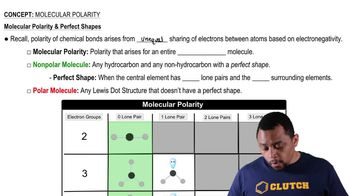
Molecular polarity refers to the distribution of electrical charge across a molecule. It is determined by the shape of the molecule and the electronegativity of its atoms. A molecule is polar if it has a net dipole moment due to an uneven distribution of charge, while nonpolar molecules have a symmetrical charge distribution.
Recommended video:
Guided course
01:34
Molecular Polarity (Simplified) Concept 1

Electronegativity

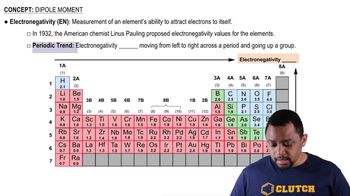
Electronegativity is a measure of an atom's ability to attract and hold onto electrons in a chemical bond. In polar molecules, there is a significant difference in electronegativity between bonded atoms, leading to unequal sharing of electrons. In contrast, nonpolar molecules have atoms with similar electronegativities, resulting in equal sharing of electrons.
Recommended video:
Guided course
01:51
Dipole Moment (Simplified) Concept 1

Molecular Geometry

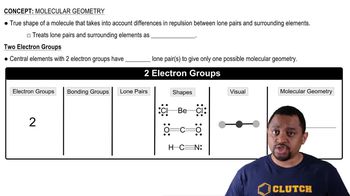
Molecular geometry refers to the three-dimensional arrangement of atoms within a molecule. The shape of a molecule affects its polarity; for example, CCl₄ has a tetrahedral shape that allows for symmetrical charge distribution, making it nonpolar. In contrast, PCl₃ has a trigonal pyramidal shape, leading to an uneven distribution of charge and making it polar.
Recommended video:
Guided course
01:30
Molecular Geometry (Simplified) Concept 1