Pearson+ LogoPearson+ Logo
Ch.7 Chemical Quantities and Reactions
Timberlake - Chemistry: An Introduction to General, Organic, and Biological Chemistry 13th Edition
Timberlake13th EditionChemistry: An Introduction to General, Organic, and Biological ChemistryISBN: 9780134421353Not the one you use?Change textbook
Chapter 7, Problem 73a

What is meant by the rate of a reaction?

Verified step by step guidance
1
The rate of a reaction refers to how quickly or slowly a chemical reaction occurs. It is typically expressed as the change in concentration of a reactant or product per unit time.
To understand the rate, consider the formula: Rate=Ct, where C represents the concentration of a reactant or product, and t represents time.
Reaction rates can be influenced by several factors, including temperature, concentration of reactants, presence of a catalyst, and the physical state of the reactants.
The rate can be measured experimentally by monitoring changes in properties such as color, pressure, or mass that are related to the concentration of reactants or products.
Understanding reaction rates is crucial for controlling chemical processes in industrial applications, biological systems, and laboratory experiments.

Verified video answer for a similar problem:

This video solution was recommended by our tutors as helpful for the problem above.
Video duration:
1m
Was this helpful?

Key Concepts

Here are the essential concepts you must grasp in order to answer the question correctly.

Rate of Reaction

The rate of a reaction refers to the speed at which reactants are converted into products in a chemical reaction. It is typically measured as the change in concentration of a reactant or product per unit time, often expressed in moles per liter per second (mol/L/s). Understanding the rate of reaction is crucial for predicting how quickly a reaction will occur under various conditions.
Recommended video:
Guided course
01:07
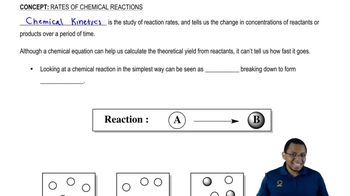
Rate of Reaction Concept 1

Factors Affecting Reaction Rate

Several factors influence the rate of a chemical reaction, including temperature, concentration of reactants, surface area, and the presence of catalysts. For instance, increasing the temperature generally increases the reaction rate by providing more energy to the molecules, leading to more frequent and effective collisions. Recognizing these factors helps in controlling and optimizing reactions in both laboratory and industrial settings.
Recommended video:
Guided course
02:16
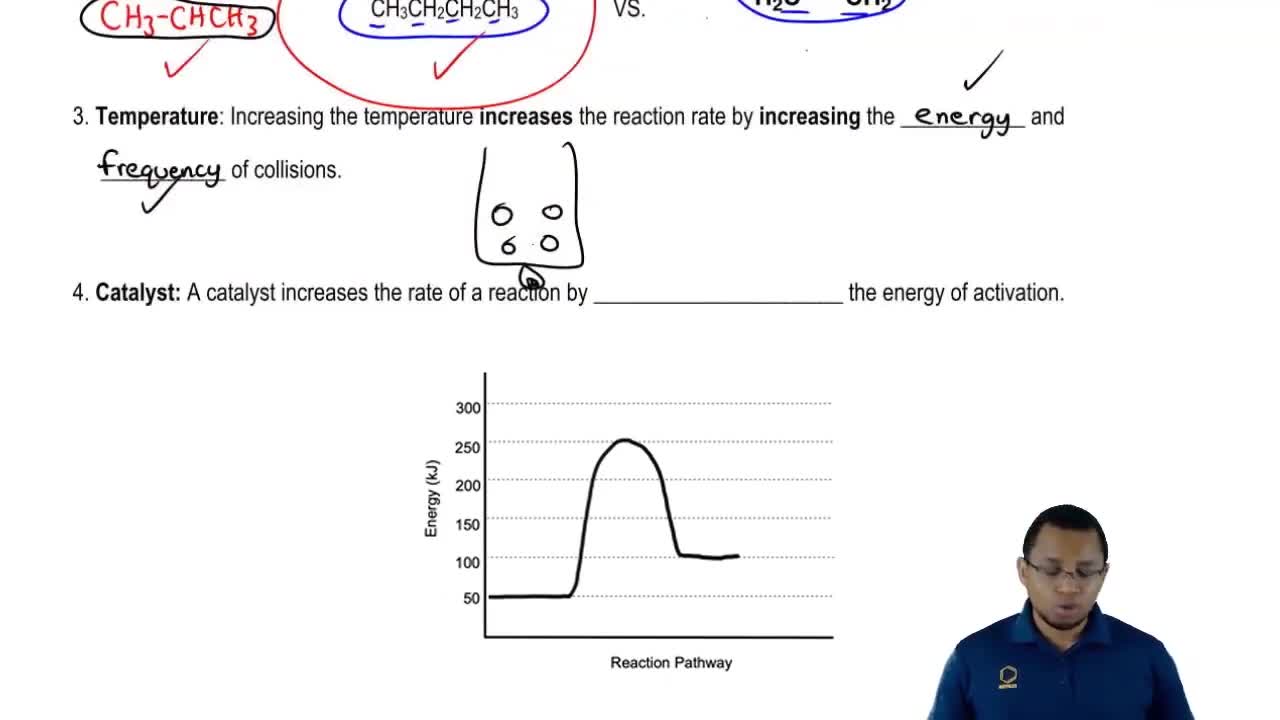
Rate of Reaction Concept 7

Reaction Mechanism

The reaction mechanism is the step-by-step sequence of elementary reactions by which overall chemical change occurs. Understanding the mechanism provides insight into how reactants transform into products and can reveal the rate-determining step, which is the slowest step that limits the overall reaction rate. This concept is essential for chemists to design more efficient reactions and predict outcomes.
Recommended video:
Guided course
1:30
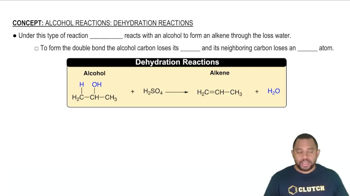
Alcohol Reactions: Dehydration Reactions Concept 1