Pearson+ LogoPearson+ Logo
Ch.7 Chemical Quantities and Reactions
Timberlake - Chemistry: An Introduction to General, Organic, and Biological Chemistry 13th Edition
Timberlake13th EditionChemistry: An Introduction to General, Organic, and Biological ChemistryISBN: 9780134421353Not the one you use?Change textbook
Chapter 7, Problem 22e

Calculate the mass, in grams, for each of the following:
e. 2.08 moles of (NH4)2SO4

Verified step by step guidance
1
Step 1: Write down the formula for the compound, (NH₄)₂SO₄, and identify the molar mass of each element in the compound. The elements are nitrogen (N), hydrogen (H), sulfur (S), and oxygen (O).
Step 2: Calculate the molar mass of (NH₄)₂SO₄ by summing the contributions of each element. Use the periodic table to find the atomic masses: N = 14.01 g/mol, H = 1.008 g/mol, S = 32.07 g/mol, and O = 16.00 g/mol. Multiply these values by the number of atoms of each element in the formula: (2 × N) + (8 × H) + (1 × S) + (4 × O).
Step 3: Add the contributions from all the elements to determine the total molar mass of (NH₄)₂SO₄. This value represents the mass of one mole of the compound in grams.
Step 4: Use the formula for mass: \( \text{Mass (g)} = \text{Moles} \times \text{Molar Mass (g/mol)} \). Substitute the given number of moles (2.08 moles) and the calculated molar mass of (NH₄)₂SO₄ into the equation.
Step 5: Perform the multiplication to find the mass in grams. Ensure that your units cancel appropriately, leaving the final answer in grams.

Verified video answer for a similar problem:

This video solution was recommended by our tutors as helpful for the problem above.
Video duration:
2m
Was this helpful?

Key Concepts

Here are the essential concepts you must grasp in order to answer the question correctly.

Mole Concept

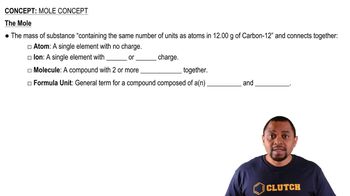
The mole is a fundamental unit in chemistry that quantifies the amount of substance. One mole contains approximately 6.022 x 10²³ entities, such as atoms or molecules. Understanding the mole concept is essential for converting between moles and grams, as it provides a bridge between the microscopic scale of atoms and the macroscopic scale of measurable quantities.
Recommended video:

Molar Mass

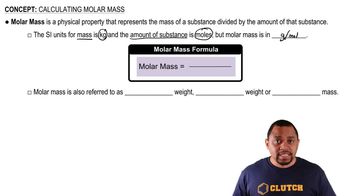
Molar mass is the mass of one mole of a substance, typically expressed in grams per mole (g/mol). It is calculated by summing the atomic masses of all the atoms in a molecule. For example, to find the molar mass of ammonium sulfate, (NH₄)₂SO₄, one must consider the contributions from nitrogen, hydrogen, sulfur, and oxygen in the compound.
Recommended video:
Guided course
01:10
Calculating Molar Mass

Stoichiometry

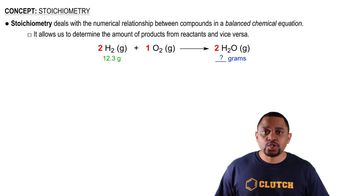
Stoichiometry is the area of chemistry that deals with the relationships between the quantities of reactants and products in chemical reactions. It allows chemists to predict how much of a substance is needed or produced in a reaction. In this context, stoichiometry is used to calculate the mass of (NH₄)₂SO₄ from the given number of moles, ensuring accurate conversions and measurements.
Recommended video:
Guided course
01:16
Stoichiometry