Pearson+ LogoPearson+ Logo
Ch.7 Chemical Quantities and Reactions
Timberlake - Chemistry: An Introduction to General, Organic, and Biological Chemistry 13th Edition
Timberlake13th EditionChemistry: An Introduction to General, Organic, and Biological ChemistryISBN: 9780134421353Not the one you use?Change textbook
Chapter 7, Problem 49a

In the mitochondria of human cells, energy is provided by the oxidation and reduction reactions of the iron ions in the cytochromes in electron transport. Identify each of the following as an oxidation or a reduction:
a. Fe3+ + e → Fe2+

Verified step by step guidance
1
Step 1: Understand the concepts of oxidation and reduction. Oxidation is the loss of electrons, while reduction is the gain of electrons. A helpful mnemonic is 'OIL RIG' (Oxidation Is Loss, Reduction Is Gain).
Step 2: Analyze the given reaction: Fe³⁺ + e⁻ → Fe²⁺. Notice that an electron (e⁻) is being added to the Fe³⁺ ion.
Step 3: Determine the change in oxidation state. Fe³⁺ has an oxidation state of +3, and Fe²⁺ has an oxidation state of +2. The decrease in the oxidation state from +3 to +2 indicates a gain of electrons.
Step 4: Recall that gaining electrons corresponds to a reduction process. Therefore, the reaction Fe³⁺ + e⁻ → Fe²⁺ is a reduction reaction.
Step 5: Conclude that the process described in the reaction is a reduction, as the Fe³⁺ ion gains an electron to become Fe²⁺.

Verified video answer for a similar problem:

This video solution was recommended by our tutors as helpful for the problem above.
Video duration:
1m
Was this helpful?

Key Concepts

Here are the essential concepts you must grasp in order to answer the question correctly.

Oxidation and Reduction

Oxidation and reduction are chemical processes that involve the transfer of electrons between substances. Oxidation refers to the loss of electrons, resulting in an increase in oxidation state, while reduction involves the gain of electrons, leading to a decrease in oxidation state. These reactions are often coupled, meaning that when one substance is oxidized, another is reduced.
Recommended video:
Guided course
0:55
Reduction of Monosaccharides Example 1

Oxidation States

Oxidation states are a way to keep track of electron transfer in chemical reactions. Each element in a compound is assigned an oxidation state based on its electron configuration and bonding. In the reaction Fe³⁺ + e⁻ → Fe²⁺, the iron ion changes from a +3 to a +2 oxidation state, indicating that it has gained an electron and undergone reduction.
Recommended video:
Guided course
01:01
States of Matter Example 1

Cytochromes and Electron Transport Chain

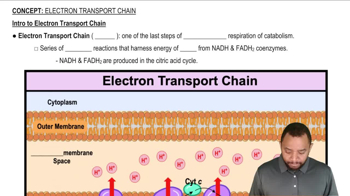
Cytochromes are heme-containing proteins found in the electron transport chain of mitochondria, playing a crucial role in cellular respiration. They facilitate the transfer of electrons through a series of redox reactions, ultimately leading to the production of ATP. The oxidation and reduction of iron ions in cytochromes are essential for the efficient transfer of energy within the cell.
Recommended video:
Guided course
3:10
Intro to Electron Transport Chain Concept 1