Pearson+ LogoPearson+ Logo
Ch.9 Solutions
Timberlake - Chemistry: An Introduction to General, Organic, and Biological Chemistry 13th Edition
Timberlake13th EditionChemistry: An Introduction to General, Organic, and Biological ChemistryISBN: 9780134421353Not the one you use?Change textbook
Chapter 9, Problem 84a

Select the diagram that represents the shape of a red blood cell when placed in each of the following a to e: (9.6)
<IMAGE>
a. 0.9% (m/v) NaCl solution

Verified step by step guidance
1
Step 1: Understand the concept of tonicity. Tonicity refers to the relative concentration of solutes in a solution compared to the solutes inside a cell. A 0.9% (m/v) NaCl solution is considered isotonic to human red blood cells.
Step 2: Analyze the effect of an isotonic solution on red blood cells. In an isotonic solution, the concentration of solutes outside the cell is equal to the concentration inside the cell, so there is no net movement of water across the cell membrane.
Step 3: Predict the shape of the red blood cell in an isotonic solution. Since there is no net movement of water, the red blood cell maintains its normal shape, which is a biconcave disk.
Step 4: Compare the diagrams provided. Diagram A represents a normal red blood cell in its biconcave disk shape, which matches the expected shape in an isotonic solution.
Step 5: Conclude that the correct diagram for a red blood cell in a 0.9% (m/v) NaCl solution is Diagram A, as it represents the normal shape of the cell in an isotonic environment.

Verified video answer for a similar problem:

This video solution was recommended by our tutors as helpful for the problem above.
Video duration:
1m
Was this helpful?

Key Concepts

Here are the essential concepts you must grasp in order to answer the question correctly.

Red Blood Cell Structure

Red blood cells (RBCs) are biconcave discs that facilitate gas exchange by maximizing surface area. Their unique shape allows them to deform as they navigate through narrow capillaries, ensuring efficient oxygen delivery and carbon dioxide removal. Understanding this structure is crucial for analyzing how RBCs respond to different osmotic environments.
Recommended video:
Guided course
2:34
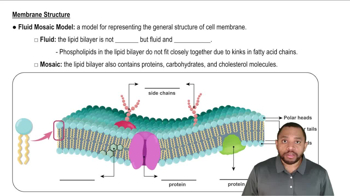
Cell Membranes Concept 2

Osmosis and Tonicity

Osmosis is the movement of water across a semipermeable membrane from an area of lower solute concentration to an area of higher solute concentration. Tonicity refers to the relative concentration of solutes in a solution compared to the cell's interior. Solutions can be isotonic, hypotonic, or hypertonic, affecting the shape and volume of RBCs based on the surrounding environment.
Recommended video:
Guided course
04:29
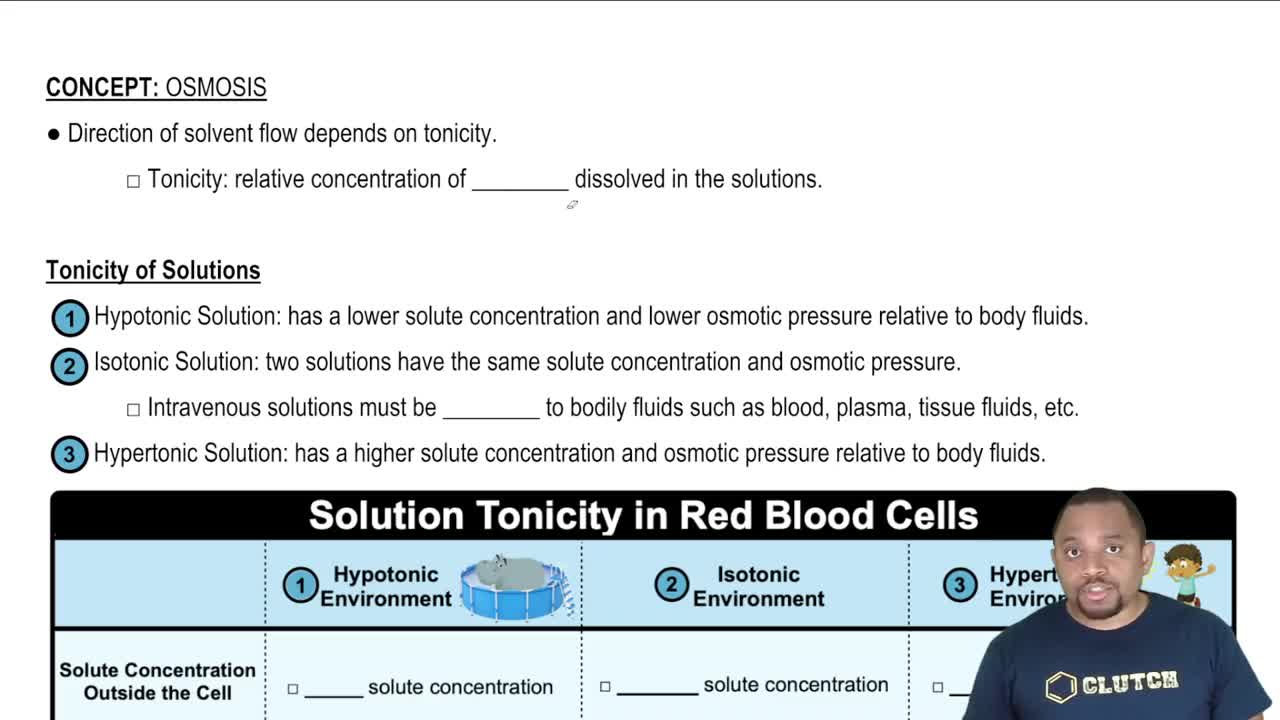
Osmosis Concept 3

Isotonic Solutions

An isotonic solution has the same solute concentration as the inside of the cell, resulting in no net movement of water. In a 0.9% (m/v) NaCl solution, which is isotonic to human blood, red blood cells maintain their normal biconcave shape. This concept is essential for understanding how cells behave in different solutions and the importance of maintaining osmotic balance.
Recommended video: