Table of contents
- 1. Introduction to Macroeconomics
- 2. Introductory Economic Models
- 3. Supply and Demand
- Introduction to Supply and Demand
- The Basics of Demand
- Individual Demand and Market Demand
- Shifting Demand
- The Basics of Supply
- Individual Supply and Market Supply
- Shifting Supply
- Overview of Supply and Demand Shifts
- Supply and Demand Together: Equilibrium, Shortage, and Surplus
- Supply and Demand Together: One-sided Shifts
- Supply and Demand Together: Both Shift
- Supply and Demand: Quantitative Analysis
- 4. Elasticity
- Percentage Change and Price Elasticity of Demand
- Elasticity and the Midpoint Method
- Price Elasticity of Demand on a Graph
- Determinants of Price Elasticity of Demand
- Total Revenue Test
- Total Revenue Along a Linear Demand Curve
- Income Elasticity of Demand
- Cross-Price Elasticity of Demand
- Price Elasticity of Supply
- Price Elasticity of Supply on a Graph
- Elasticity Summary
- 5. Consumer and Producer Surplus; Price Ceilings and Price Floors
- Willingness to Pay and Consumer Surplus
- Willingness to Sell and Producer Surplus
- Economic Surplus and Efficiency
- Quantitative Analysis of Consumer and Producer Surplus at Equilibrium
- Price Ceilings, Price Floors, and Black Markets
- Quantitative Analysis of Price Ceilings and Floors: Finding Points
- Quantitative Analysis of Price Ceilings and Floors: Finding Areas
- 6. Introduction to Taxes
- 7. Externalities
- 8. The Types of Goods
- 9. International Trade
- 10. Measuring National Output and Income
- 11. Unemployment and Inflation
- Labor Force and Unemployment
- Types of Unemployment
- Unemployment: Minimum Wage Laws and Efficiency Wages
- Inflation and Consumer Price Index (CPI)
- Using CPI to Adjust for Inflation
- Problems with the Consumer Price Index (CPI)
- Nominal Income and Real Income
- Nominal Interest, Real Interest, and the Fisher Equation
- Who is Affected by Inflation?
- Demand-Pull and Cost-Push Inflation
- Costs of Inflation: Shoe-leather Costs and Menu Costs
- 12. Productivity and Economic Growth
- 13. The Financial System
- 14. Income and Consumption
- 15. Deriving the Aggregate Expenditures Model
- 16. Aggregate Demand and Aggregate Supply Analysis
- 17. The Monetary System
- 18. Monetary Policy
- 19. Fiscal Policy
- 20. Tradeoffs Between Inflation and Unemployment
- 21. Open-Economy Macroeconomics
- Balance of Payments: Introduction
- Balance of Payments: Current Account
- Balance of Payments: Financial Account and Capital Account
- Net Exports Equal Net Foreign Investment
- Balance of Trade; Trade Deficit and Trade Surplus
- Exchange Rates: Introduction
- Exchange Rates: Nominal and Real
- Exchange Rates: Equilibrium
- Exchange Rates: Shifts in Supply and Demand
- Exchange Rates and Net Exports
- Exchange Rates: Purchasing Power Parity
- The Gold Standard
- The Bretton Woods System
- 22. Macroeconomic Schools of Thought
- 23. Dynamic AD/AS Model
11. Unemployment and Inflation
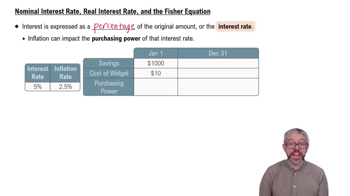
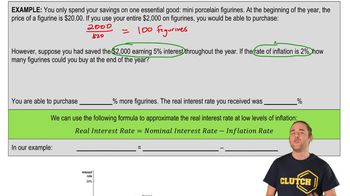
Nominal Interest, Real Interest, and the Fisher Equation
11. Unemployment and Inflation
Nominal Interest, Real Interest, and the Fisher Equation
 05:05
05:05

Learn with other creators

Practice this topic
- Multiple ChoiceWhich of the following is an inflation-adjusted return on a loan or bond (i.e., the real interest rate) according to the Fisher relationship?129views
- Multiple ChoiceWhich of the following is an inflation-adjusted return (i.e., a measure of return that accounts for changes in the price level)?123views
- Multiple ChoiceAccording to the Fisher equation, if expected inflation rises while the real interest rate remains unchanged, how will nominal bond yields typically change?150views
- Multiple Choice
What is the Fisher equation?
67views