


Ch. 15 - Microbial Mechanisms of Pathogenicity
Tortora - Microbiology: An Introduction 14th Edition
Tortora14th EditionMicrobiology: An IntroductionISBN: 9780138200398Not the one you use?Change textbook
Chapter 11, Problem 10

The Opa gene is used to identify this endotoxin-producing bacterium that grows well in the high- CO₂ conditions inside phagocytes.

Verified step by step guidance
1
Identify the bacterium described by the problem: it produces endotoxin, grows well in high-CO₂ conditions inside phagocytes, and is associated with the Opa gene.
Recall that the Opa gene encodes opacity-associated proteins involved in bacterial adherence and invasion, which is characteristic of Neisseria species.
Understand that endotoxins are lipopolysaccharides (LPS) found in the outer membrane of Gram-negative bacteria, such as Neisseria gonorrhoeae and Neisseria meningitidis.
Recognize that Neisseria gonorrhoeae is known for expressing Opa proteins and thriving in high-CO₂ environments, especially inside phagocytic cells.
Conclude that the bacterium identified by the Opa gene and described conditions is Neisseria gonorrhoeae.

Verified video answer for a similar problem:

This video solution was recommended by our tutors as helpful for the problem above.
Video duration:
2m

Key Concepts

Here are the essential concepts you must grasp in order to answer the question correctly.

Opa Gene and Its Role in Bacterial Identification

The Opa gene encodes opacity-associated proteins found in certain bacteria, notably Neisseria species. These proteins facilitate bacterial adhesion and invasion of host cells, making the Opa gene a useful molecular marker for identifying these pathogens.
Recommended video:
05:00
Prokaryotic Sigma (σ) Factors

Endotoxins in Gram-negative Bacteria

Endotoxins are lipopolysaccharide components of the outer membrane of Gram-negative bacteria. They trigger strong immune responses and are key virulence factors, helping to identify bacteria that produce them, such as Neisseria gonorrhoeae.
Recommended video:
02:20
Gram-Positive & Gram-Negative Bacteria

Bacterial Growth in High CO₂ Environments Inside Phagocytes

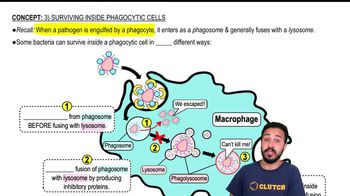
Some bacteria, like Neisseria species, thrive in high CO₂ conditions found inside phagocytic cells. This adaptation allows them to survive and multiply within host immune cells, contributing to their pathogenicity and aiding in their identification.
Recommended video:
04:18
Surviving Inside Phagocytic Cells