A 10-cm-diameter parallel-plate capacitor has a 1.0 mm spacing. The electric field between the plates is increasing at the rate 1.0×10⁶ V/m s. What is the magnetic field strength on the axis?
Ch 31: Electromagnetic Fields and Waves
Knight Calc5th EditionPhysics for Scientists and EngineersISBN: 9780137344796Not the one you use?Change textbook
Chapter 31, Problem 6
What capacitance, in μF, has its potential difference increasing at 1.0×10⁶ V/s when the displacement current in the capacitor is 1.0 A?
Verified step by step guidance1
Start by recalling the relationship between the displacement current (I_d), the capacitance (C), and the rate of change of the potential difference (dV/dt). The formula is: .
Rearrange the formula to solve for capacitance (C): .
Substitute the given values into the formula. The displacement current is , and the rate of change of potential difference is .
Perform the division to calculate the capacitance: . This will give the capacitance in farads (F).
Convert the result from farads (F) to microfarads (μF) by multiplying by , since .

Verified video answer for a similar problem:
This video solution was recommended by our tutors as helpful for the problem above.
Was this helpful?
Key Concepts
Here are the essential concepts you must grasp in order to answer the question correctly.
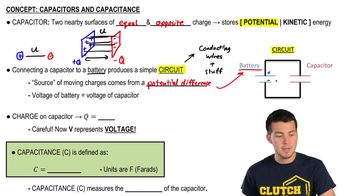
Capacitance
Capacitance is the ability of a capacitor to store electric charge per unit voltage. It is defined as the ratio of the electric charge (Q) stored on one plate of the capacitor to the potential difference (V) across the plates, expressed as C = Q/V. The unit of capacitance is the farad (F), and in this context, we are converting it to microfarads (μF), where 1 μF = 10^-6 F.
Recommended video:
Guided course
Capacitors & Capacitance (Intro)
Displacement Current
Displacement current is a concept introduced by James Clerk Maxwell to account for changing electric fields in capacitors. It is defined as the rate of change of electric displacement field (D) and is given by the equation I_d = ε_0 (dΦ_E/dt), where ε_0 is the permittivity of free space and Φ_E is the electric flux. In this scenario, the displacement current is equivalent to the actual current flowing through the capacitor, which is 1.0 A.
Recommended video:
Guided course
Displacement vs. Distance
Rate of Change of Voltage
The rate of change of voltage across a capacitor is crucial for understanding how quickly the electric field within the capacitor is changing. It is expressed as dV/dt, and in this case, it is given as 1.0×10^6 V/s. This rate, combined with the displacement current, allows us to relate the capacitance to the current and the changing voltage using the formula I = C(dV/dt), which is essential for solving the problem.
Recommended video:
Guided course
Alternating Voltages and Currents
Related Practice
Textbook Question
77
views
Textbook Question
Show that the quantity ϵ0(dΦe/dt) has units of current.
83
views
Textbook Question
A rocket zooms past the earth at v=2.0×10⁶ m/s. Scientists on the rocket have created the electric and magnetic fields shown in FIGURE EX31.4. What are the fields measured by an earthbound scientist?
1408
views
Textbook Question
A rocket cruises past a laboratory at 1.00×10⁶ m/s in the positive x-direction just as a proton is launched with velocity (in the laboratory frame) m/s. What are the proton's speed and its angle from the y-axis in the rocket frame?
1094
views
Textbook Question
The magnetic field of an electromagnetic wave in a vacuum is , where x is in m and t is in s. What are the wave's wavelength?
216
views