
Ch 02: Motion Along a Straight Line
Young & Freedman Calc - University Physics 14th Edition
Young & Freedman Calc14th EditionUniversity PhysicsISBN: 9780321973610Not the one you use?Change textbook
Chapter 2, Problem 54a

High-speed motion pictures (35003500 frames/second) of a jumping, 210μg210–μg flea yielded the data used to plot the graph in Fig. E2.542.54. (See 'The Flying Leap of the Flea' by M. Rothschild, Y. Schlein, K. Parker, C. Neville, and S. Sternberg in the November 19731973 Scientific American.) This flea was about 22 mm long and jumped at a nearly vertical takeoff angle. Use the graph to answer this question: Is the acceleration of the flea ever zero? If so, when? Justify your answer.
Speed-time graph illustrating the acceleration of a flea's jump, with speed in cm/s and time in ms.

Verified step by step guidance
1
Examine the graph provided. The graph shows the velocity of the flea over time. The x-axis represents time in milliseconds (ms), and the y-axis represents velocity in meters per second (m/s).
Identify the regions of the graph where the velocity is constant. A constant velocity indicates that the acceleration is zero because acceleration is the rate of change of velocity.
Notice that after approximately 150 ms, the velocity becomes constant at around 8 m/s. This indicates that the flea's acceleration is zero during this period.
Understand that acceleration is the derivative of velocity with respect to time. When the slope of the velocity-time graph is zero, the acceleration is zero.
Conclude that the flea's acceleration is zero when the velocity is constant, which occurs after the initial acceleration phase, around 150 ms onwards.

Verified video answer for a similar problem:

This video solution was recommended by our tutors as helpful for the problem above.
Video duration:
2m
Was this helpful?

Key Concepts

Here are the essential concepts you must grasp in order to answer the question correctly.

Acceleration

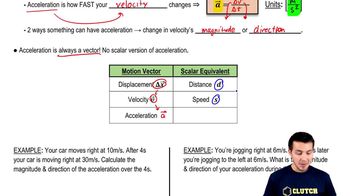
Acceleration is defined as the rate of change of velocity over time. It can be positive, negative, or zero. In the context of the flea's jump, acceleration is crucial for understanding how the flea increases its speed during takeoff and whether it ever stops accelerating, which would indicate a moment of zero acceleration.
Recommended video:
Guided course
05:47
Intro to Acceleration

Speed-Time Graph

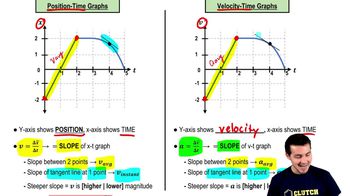
A speed-time graph visually represents an object's speed over time. The slope of the graph indicates acceleration; a flat line indicates constant speed, while a rising line indicates increasing speed. Analyzing the graph of the flea's jump helps determine when the flea's speed is constant, which corresponds to zero acceleration.
Recommended video:
Guided course
05:59
Velocity-Time Graphs & Acceleration

Kinematics of Jumping

Kinematics is the study of motion without considering the forces that cause it. In the case of the flea's jump, understanding the kinematics involves analyzing the initial takeoff, the peak of the jump, and the descent. This analysis helps identify the phases of motion where acceleration may be zero, particularly when the flea reaches its maximum height and momentarily stops before descending.
Recommended video:
Guided course
14:28
Jumping into a moving disc
Related Practice
Textbook Question

A rocket starts from rest and moves upward from the surface of the earth. For the first 10.010.0 s of its motion, the vertical acceleration of the rocket is given by ay=(2.80a_{y}=(2.80 m/s3)t)t, where the +y+y-direction is upward. What is the height of the rocket above the surface of the earth at t=10.0t = 10.0 s?

3288
views
Textbook Question

High-speed motion pictures (35003500 frames/second) of a jumping, 210μg210–μg flea yielded the data used to plot the graph in Fig. E2.542.54. (See 'The Flying Leap of the Flea' by M. Rothschild, Y. Schlein, K. Parker, C. Neville, and S. Sternberg in the November 19731973 Scientific American.) This flea was about 22 mm long and jumped at a nearly vertical takeoff angle. Use the graph to answer this question: Find the flea's acceleration at 0.50.5 ms, 1.01.0 ms, and 1.51.5 ms.


1487
views
Textbook Question

High-speed motion pictures (35003500 frames/second) of a jumping, 210μg210–μg flea yielded the data used to plot the graph in Fig. E2.542.54. (See 'The Flying Leap of the Flea' by M. Rothschild, Y. Schlein, K. Parker, C. Neville, and S. Sternberg in the November 19731973 Scientific American.) This flea was about 22 mm long and jumped at a nearly vertical takeoff angle. Use the graph to answer this question: Find the maximum height the flea reached in the first 2.52.5 ms.

1755
views
Textbook Question

A small rocket burns 0.0500 kg of fuel per second, ejecting it as a gas with a velocity relative to the rocket of magnitude 1600 m/s. Would the rocket operate in outer space where there is no atmosphere? If so, how would you steer it? Could you brake it?

1508
views
Textbook Question

A rocket starts from rest and moves upward from the surface of the earth. For the first 10.010.0 s of its motion, the vertical acceleration of the rocket is given by ay=(2.80a_{y}=(2.80 m/s3)t)t, where the +y+y-direction is upward. What is the speed of the rocket when it is 325325 m above the surface of the earth?

1936
views
Textbook Question

You throw a small rock straight up from the edge of a highway bridge that crosses a river. The rock passes you on its way down, 6.006.00 s after it was thrown. What is the speed of the rock just before it reaches the water 28.028.0 m below the point where the rock left your hand? Ignore air resistance.

7112
views
2
comments