Ch 28: Sources of Magnetic Field
Young & Freedman Calc - University Physics 14th Edition
Young & Freedman Calc14th EditionUniversity PhysicsISBN: 9780321973610Not the one you use?Change textbook
Chapter 28, Problem 25

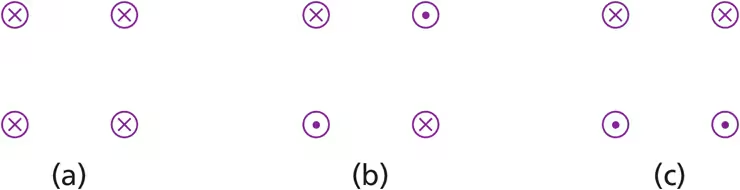
Four long, parallel power lines each carry 100 A currents. A cross-sectional diagram of these lines is a square, 20.0 cm on each side. For each of the three cases shown in Fig. E28.25, calculate the magnetic field at the center of the square.

Verified step by step guidance
1
Identify the configuration of the currents in the wires. In the image, wires A and B have currents coming out of the page, while wires C and D have currents going into the page.
Use the Biot-Savart Law to calculate the magnetic field due to a long straight wire at a point. The magnetic field due to a wire is given by: B=μI2πr, where μ is the permeability of free space, I is the current, and r is the distance from the wire.
Calculate the distance from each wire to the center of the square. Since the square is 20 cm on each side, the distance from each corner to the center is 22 times the side length, which is 202 cm.
Determine the direction of the magnetic field at the center due to each wire using the right-hand rule. For wires A and B, the field will be counterclockwise, and for wires C and D, it will be clockwise.
Add the contributions of the magnetic fields from each wire vectorially. Since wires A and B have currents in the opposite direction to wires C and D, their magnetic fields will partially cancel each other out at the center. Calculate the net magnetic field by considering the vector sum of the individual fields.

Verified video answer for a similar problem:

This video solution was recommended by our tutors as helpful for the problem above.
Video duration:
6m
Was this helpful?

Key Concepts

Here are the essential concepts you must grasp in order to answer the question correctly.

Biot-Savart Law

The Biot-Savart Law describes the magnetic field generated by a steady current. It states that the magnetic field dB at a point in space is proportional to the current I, the length element dl, and inversely proportional to the square of the distance r from the current element to the point. This law is essential for calculating the magnetic field at the center of the square formed by the power lines.
Recommended video:
Guided course
04:53
Biot-Savart Law with Calculus

Superposition Principle

The superposition principle allows us to calculate the net magnetic field at a point by summing the individual magnetic fields produced by each current-carrying wire. Since the magnetic field is a vector quantity, both magnitude and direction must be considered. This principle is crucial for determining the total magnetic field at the center of the square formed by the four power lines.
Recommended video:
Guided course
03:32
Superposition of Sinusoidal Wave Functions

Right-Hand Rule

The right-hand rule is a mnemonic for determining the direction of the magnetic field around a current-carrying wire. By pointing the thumb of the right hand in the direction of the current, the fingers curl in the direction of the magnetic field lines. This rule helps in visualizing the direction of the magnetic fields produced by each wire, which is necessary for applying the superposition principle effectively.
Recommended video:
Guided course
19:11
Force on Moving Charges & Right Hand Rule