
Ch. 34 - The Wave Nature of Light: Interference and Polarization
Giancoli Douglas - Physics for Scientists and Engineers 5th edition
Giancoli Douglas5th editionPhysics for Scientists and EngineersISBN: 9780137488179Not the one you use?Change textbook
Chapter 33, Problem 75

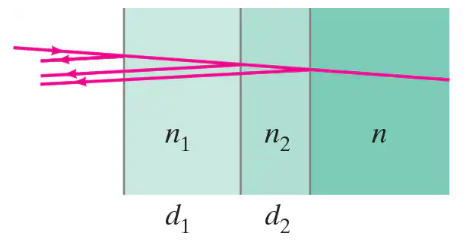
A highly reflective mirror can be made for a particular wavelength at normal incidence by using two thin layers of transparent materials of indices of refraction n₁ and n₂ ( 1 < n₁ < n₂ ) on the surface of the glass (n > n₂). What should be the minimum thicknesses d₁ and d₂ in Fig. 34–49 in terms of the incident wavelength λ, to maximize reflection?

Verified step by step guidance
1
Step 1: Understand the problem. The goal is to maximize reflection for a particular wavelength λ at normal incidence using two thin layers of transparent materials with refractive indices n₁ and n₂. The thicknesses of these layers, d₁ and d₂, need to be determined.
Step 2: Recall the principle of constructive interference. For maximum reflection, the reflected waves from the interfaces of the layers must interfere constructively. This occurs when the optical path difference between the reflected waves is an integer multiple of the wavelength.
Step 3: Consider the phase change upon reflection. At the interface between materials with different refractive indices, a phase change of π (half a wavelength) occurs if the wave reflects off a medium with a higher refractive index. This must be accounted for in the calculation.
Step 4: Write the condition for constructive interference. The optical path difference for each layer is given by twice the thickness of the layer multiplied by its refractive index. For constructive interference, this path difference must equal an integer multiple of the wavelength divided by the refractive index of the layer. Mathematically: d1=λ4 and d2=λ4.
Step 5: Conclude the minimum thicknesses. To maximize reflection, the minimum thicknesses of the layers should be such that the optical path difference corresponds to a quarter of the wavelength for each layer. This ensures constructive interference and maximizes reflection.

Verified video answer for a similar problem:

This video solution was recommended by our tutors as helpful for the problem above.
Video duration:
6m
Was this helpful?

Key Concepts

Here are the essential concepts you must grasp in order to answer the question correctly.

Thin Film Interference

Thin film interference occurs when light waves reflect off the boundaries of a thin layer of material, leading to constructive or destructive interference. This phenomenon is crucial for understanding how the thickness of the layers affects the reflection of specific wavelengths of light. The condition for maximum reflection is achieved when the path difference between the reflected waves is an integer multiple of the wavelength.
Recommended video:
Guided course
03:47
Wave Interference & Superposition

Index of Refraction

The index of refraction (n) is a measure of how much light slows down when passing through a material compared to its speed in a vacuum. In this context, the indices of refraction of the layers (n₁ and n₂) determine how light interacts with the layers, influencing the phase change upon reflection and the conditions for constructive interference necessary for maximizing reflection.
Recommended video:
Guided course
03:46
Index of Refraction

Phase Change upon Reflection

When light reflects off a medium with a higher index of refraction, it undergoes a phase change of π (or half a wavelength). This phase change is critical in determining the conditions for constructive interference in thin films. Understanding when and how this phase change occurs helps in calculating the required thicknesses of the layers to achieve maximum reflection for the desired wavelength.
Recommended video:
Guided course
10:40
Latent Heat & Phase Changes
Related Practice
Textbook Question

Consider two antennas radiating 6.8-MHz radio waves in phase with each other. They are located at points S₁ and S₂, separated by a distance d = 175 m, Fig. 34–50. Determine the points on the positive y-axis where the signals from the two sources will be out of phase (crests of one meet troughs of the other).

64
views
Textbook Question

Two narrow slits 0.070 mm apart are illuminated by a very bright 488-nm light source forming an interference pattern on a screen 4.0 m away. Calculate (a) the distance between the m = 0 and m = 1 lines in the pattern and (b) the distance between the m = 100 and m = 101 lines.

1231
views
Textbook Question

Light of wavelength 5.0 x 10⁻⁷ passes through two parallel slits and falls on a screen 5.0 m away. Adjacent bright bands of the interference pattern are 2.0 cm apart.

(a) Find the distance between the slits.

(b) The same two slits are next illuminated by light of a different wavelength, and the fifth minimum for this light occurs at the same point on the screen as the fourth minimum for the previous light. What is the wavelength of the second source of light?

60
views
Textbook Question

Suppose the mirrors in a Michelson interferometer are perfectly aligned and the path lengths to mirrors M₁ and M₂ are identical. With these initial conditions, an observer sees a bright maximum at the center of the viewing area. Now one of the mirrors is moved a distance x. Determine a formula for the intensity at the center of the viewing area as a function of x, the distance the movable mirror is moved from the initial position.

64
views
Textbook Question

Light of wavelength 690 nm passes through two narrow slits 0.66 mm apart. The screen is 1.75 m away. A second source of unknown wavelength produces its second-order fringe 1.23 mm closer to the central maximum than the 690-nm light. What is the wavelength of the unknown light?

59
views
Textbook Question

Unpolarized light falls on two polarizer sheets whose axes are at right angles. (a) What fraction of the incident light intensity is transmitted? (b) What fraction is transmitted if a third polarizer is placed between the first two so that its axis makes a 58° angle with the axis of the first polarizer? (c) What if the third polarizer is in front of the other two?

65
views