Ch. 20 - Second Law of Thermodynamics
Giancoli Douglas - Physics for Scientists and Engineers 5th edition
Giancoli Douglas5th editionPhysics for Scientists and EngineersISBN: 9780137488179Not the one you use?Change textbook
Chapter 20, Problem 53a

Why would you expect the total entropy change in a Carnot cycle to be zero?

Verified step by step guidance
1
The Carnot cycle is a theoretical thermodynamic cycle that is reversible, meaning all processes within the cycle can be reversed without any loss of energy or increase in entropy. This is a key property of the Carnot cycle.
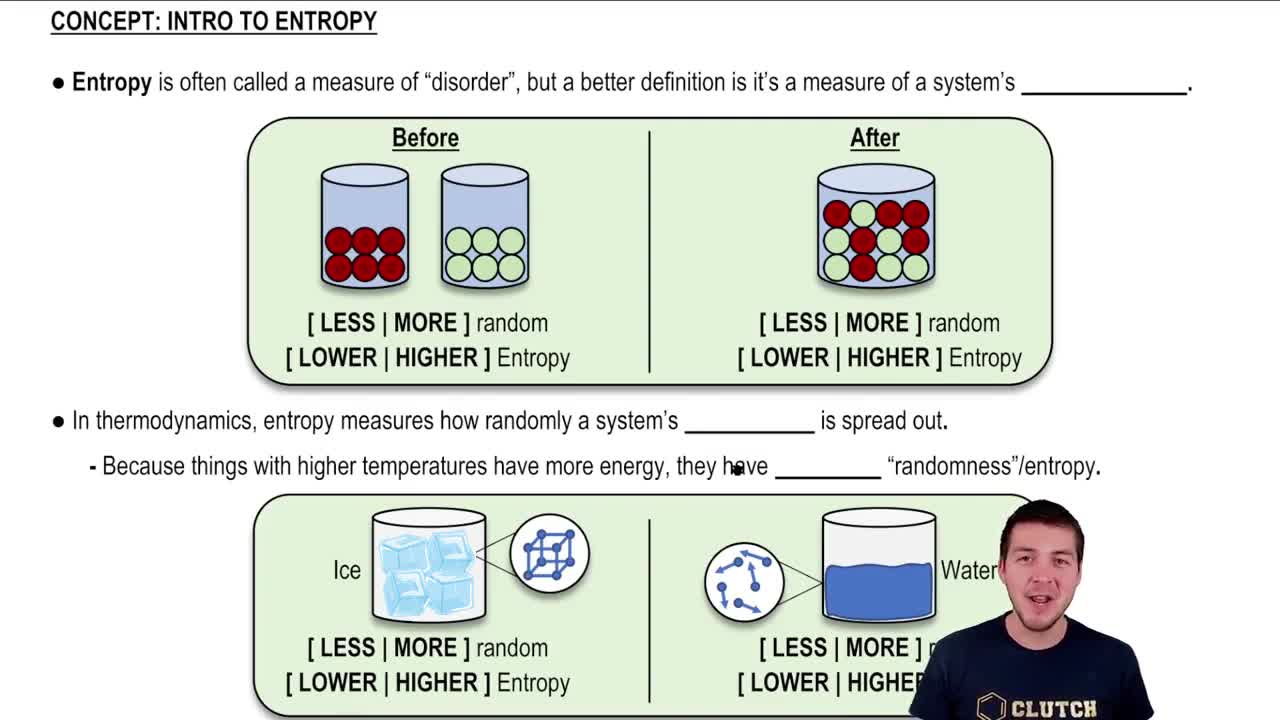
Entropy is a measure of the disorder or randomness in a system. In a reversible process, the entropy change of the system and its surroundings is perfectly balanced, resulting in no net change in entropy.
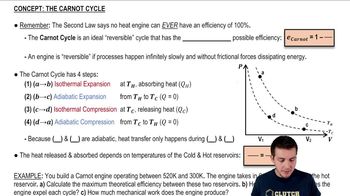
During the Carnot cycle, heat is absorbed from a high-temperature reservoir during the isothermal expansion phase, and an equivalent amount of heat is rejected to a low-temperature reservoir during the isothermal compression phase. The entropy gained by the system during heat absorption is exactly equal to the entropy lost during heat rejection.
Mathematically, the entropy change for the system during heat absorption is ΔS = Q_h / T_h, where Q_h is the heat absorbed and T_h is the temperature of the hot reservoir. Similarly, the entropy change during heat rejection is ΔS = -Q_c / T_c, where Q_c is the heat rejected and T_c is the temperature of the cold reservoir. For a Carnot cycle, these changes cancel out.
Since the Carnot cycle is reversible and the entropy changes of the system and surroundings are equal and opposite, the total entropy change for the entire cycle is zero. This is a fundamental property of reversible processes in thermodynamics.

Verified video answer for a similar problem:

This video solution was recommended by our tutors as helpful for the problem above.
Video duration:
2m
Was this helpful?

Key Concepts

Here are the essential concepts you must grasp in order to answer the question correctly.

Carnot Cycle

The Carnot cycle is a theoretical thermodynamic cycle that provides the maximum possible efficiency for a heat engine operating between two temperature reservoirs. It consists of four reversible processes: two isothermal (constant temperature) and two adiabatic (no heat exchange). This idealized cycle serves as a benchmark for real engines, illustrating the principles of thermodynamics and efficiency.
Recommended video:
Guided course
06:28
The Carnot Cycle and Maximum Theoretical Efficiency

Entropy

Entropy is a measure of the disorder or randomness in a system, and it quantifies the amount of energy in a physical system that is not available to do work. In thermodynamics, the second law states that the total entropy of an isolated system can never decrease over time, leading to the conclusion that processes occur in the direction of increasing entropy. Understanding entropy is crucial for analyzing energy transformations in thermodynamic cycles.
Recommended video:
Guided course
07:50
Intro to Entropy

Reversibility

A reversible process is an idealized process that can be reversed without leaving any change in the system or surroundings. In the context of the Carnot cycle, all processes are considered reversible, meaning that they can be conducted in such a way that the system returns to its initial state without any net change in entropy. This concept is essential for understanding why the total entropy change in a Carnot cycle is zero, as the entropy gained during heat absorption is exactly balanced by the entropy lost during heat rejection.
Recommended video:
Guided course
06:28
The Carnot Cycle and Maximum Theoretical Efficiency