Ch 32: AC Circuits
Knight Calc - Physics for Scientists and Engineers 5th Edition
Knight Calc5th EditionPhysics for Scientists and EngineersISBN: 9780137344796Not the one you use?Change textbook
Chapter 32, Problem 8a

The peak current to and from a capacitor is 10 mA. What is the peak current if the emf frequency is doubled?

Verified step by step guidance
1
Understand the relationship between the current through a capacitor and the frequency of the applied emf. The current through a capacitor is given by the formula: I = C ω V, where I is the current, C is the capacitance, ω is the angular frequency, and V is the peak voltage.
Recall that the angular frequency ω is related to the frequency f by the equation: ω = 2πf. Doubling the frequency f will also double the angular frequency ω.
Since the current I is directly proportional to the angular frequency ω, doubling the frequency will result in the current also being doubled.
The initial peak current is given as 10 mA. Therefore, if the frequency is doubled, the new peak current will be twice the initial peak current.
Conclude that the new peak current can be calculated as Inew = 2 × 10 mA. Perform this multiplication to find the final value if needed.

Verified video answer for a similar problem:

This video solution was recommended by our tutors as helpful for the problem above.
Was this helpful?

Key Concepts

Here are the essential concepts you must grasp in order to answer the question correctly.

Capacitive Reactance

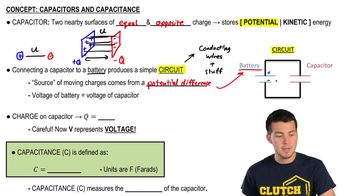
Capacitive reactance (Xc) is the opposition that a capacitor offers to alternating current (AC) due to its capacitance. It is inversely proportional to both the frequency of the AC signal and the capacitance value, described by the formula Xc = 1/(2πfC). As frequency increases, capacitive reactance decreases, allowing more current to flow through the capacitor.
Recommended video:
Guided course
08:02
Capacitors & Capacitance (Intro)

Ohm's Law in AC Circuits

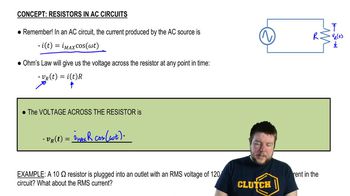
Ohm's Law, which states that voltage (V) equals current (I) times resistance (R), also applies to AC circuits but must consider impedance (Z) instead of resistance. In capacitive circuits, the relationship between current and voltage is affected by the frequency of the AC signal, leading to variations in current as frequency changes.
Recommended video:
Guided course
03:12
Resistors in AC Circuits

Frequency and Current Relationship

In AC circuits, the frequency of the electromotive force (emf) directly influences the current flowing through capacitive components. When the frequency is doubled, the capacitive reactance decreases, resulting in an increase in peak current. This relationship is crucial for understanding how changes in frequency affect the behavior of capacitors in circuits.
Recommended video:
Guided course
05:08
Circumference, Period, and Frequency in UCM