
Ch 22: Gauss' Law
Young & Freedman Calc - University Physics 14th Edition
Young & Freedman Calc14th EditionUniversity PhysicsISBN: 9780321973610Not the one you use?Change textbook
Chapter 22, Problem 24a

Charge qq is distributed uniformly throughout the volume of an insulating sphere of radius R=4.00R = 4.00 cm. At a distance of r=8.00r = 8.00 cm from the center of the sphere, the electric field due to the charge distribution has magnitude E=940E = 940 N/C. What is the volume charge density for the sphere?

Verified step by step guidance
1
Understand that the problem involves a uniformly charged insulating sphere, and we need to find the volume charge density \( \rho \). The electric field \( E \) is given at a point outside the sphere.
Recall Gauss's Law, which states that the electric field \( E \) due to a symmetric charge distribution can be calculated using \( E = \frac{Q}{4\pi\varepsilon_0 r^2} \), where \( Q \) is the total charge, \( \varepsilon_0 \) is the permittivity of free space, and \( r \) is the distance from the center of the sphere.
Since the electric field is given at \( r = 8.00 \) cm, which is outside the sphere, the entire charge \( Q \) of the sphere contributes to the electric field at this point.
The volume charge density \( \rho \) is defined as \( \rho = \frac{Q}{V} \), where \( V \) is the volume of the sphere. The volume \( V \) of the sphere can be calculated using the formula \( V = \frac{4}{3}\pi R^3 \), where \( R \) is the radius of the sphere.
To find \( \rho \), first solve for \( Q \) using the electric field equation: \( Q = E \cdot 4\pi\varepsilon_0 r^2 \). Then, substitute \( Q \) into the volume charge density formula \( \rho = \frac{Q}{V} \) to find \( \rho \).

Verified video answer for a similar problem:

This video solution was recommended by our tutors as helpful for the problem above.
Video duration:
4m
Was this helpful?

Key Concepts

Here are the essential concepts you must grasp in order to answer the question correctly.

Electric Field

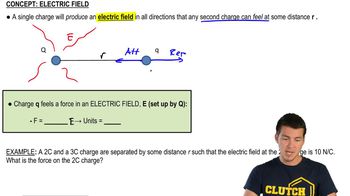
The electric field is a vector field around a charged object where a force would be exerted on other charges. It is defined as the force per unit charge and is measured in newtons per coulomb (N/C). In this problem, the electric field at a distance from the sphere is given, which helps in determining the charge distribution.
Recommended video:
Guided course
03:16
Intro to Electric Fields

Gauss's Law

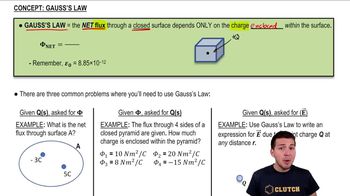
Gauss's Law relates the electric flux through a closed surface to the charge enclosed by that surface. It is expressed as Φ = Q_enclosed/ε₀, where Φ is the electric flux, Q_enclosed is the charge within the surface, and ε₀ is the permittivity of free space. This law is crucial for calculating the electric field due to symmetric charge distributions like spheres.
Recommended video:

Volume Charge Density

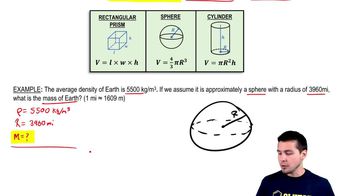
Volume charge density (ρ) is the measure of electric charge per unit volume within a region. It is expressed in coulombs per cubic meter (C/m³). For a uniformly charged sphere, the volume charge density can be calculated by dividing the total charge by the sphere's volume, which is essential for understanding how charge is distributed within the sphere.
Recommended video:
Guided course
04:33
Problems with Mass, Volume, & Density
Related Practice
Textbook Question

A hollow, conducting sphere with an outer radius of 0.2500.250 m and an inner radius of 0.2000.200 m has a uniform surface charge density of +6.37×10⁶+6.37\(\times\)10^{-6} C/m2. A charge of 0.500−0.500 μ\(\mu\)C is now introduced at the center of the cavity inside the sphere. What is the electric flux through a spherical surface just inside the inner surface of the sphere?

1893
views
Textbook Question

A very large, horizontal, nonconducting sheet of charge has uniform charge per unit area σ=5.00×10⁶\(\sigma\)=5.00\(\times\)10^{-6} C/m2. A small sphere of mass m=8.00×10⁶m=8.00\(\times\)10^{-6} kg and charge qq is placed 3.00 3.00 cm above the sheet of charge and then released from rest. If the sphere is to remain motionless when it is released, what must be the value of qq?

2571
views
Textbook Question

A conductor with an inner cavity, like that shown in Fig. 22.2322.23c, carries a total charge of +5.00+5.00 nC. The charge within the cavity, insulated from the conductor, is 6.00−6.00 nC. How much charge is on (a) the inner surface of the conductor and (b) the outer surface of the conductor?

3054
views
Textbook Question

A hollow, conducting sphere with an outer radius of 0.2500.250 m and an inner radius of 0.2000.200 m has a uniform surface charge density of +6.37×10⁶+6.37\(\times\)10^{-6} C/m2. A charge of 0.500−0.500 μ\(\mu\)C is now introduced at the center of the cavity inside the sphere. What is the new charge density on the outside of the sphere?

1998
views
Textbook Question

Charge qq is distributed uniformly throughout the volume of an insulating sphere of radius R=4.00R = 4.00 cm. At a distance of r=8.00r = 8.00 cm from the center of the sphere, the electric field due to the charge distribution has magnitude E=940E = 940 N/C. What is the electric field at a distance of 2.002.00 cm from the sphere's center?

2034
views
Textbook Question

A hollow, conducting sphere with an outer radius of 0.2500.250 m and an inner radius of 0.2000.200 m has a uniform surface charge density of +6.37×10⁶+6.37\(\times\)10^{-6} C/m2. A charge of 0.500−0.500 μ\(\mu\)C is now introduced at the center of the cavity inside the sphere. Calculate the strength of the electric field just outside the sphere?

3585
views