Ch 13: Newton's Theory of Gravity
Knight Calc - Physics for Scientists and Engineers 5th Edition
Knight Calc5th EditionPhysics for Scientists and EngineersISBN: 9780137344796Not the one you use?Change textbook
Chapter 13, Problem 44

Two spherical objects have a combined mass of 400 kg. The gravitational attraction between them is 6.00 x 10⁻⁷ N and their gravitational potential energy is ₋1.20 x 10⁻⁶ J. What is the mass of each?

Verified step by step guidance
1
Step 1: Recall the formula for gravitational force between two masses: F = G * (m₁ * m₂) / r², where F is the gravitational force, G is the gravitational constant (6.674 * 10⁻¹¹ N·m²/kg²), m₁ and m₂ are the masses of the objects, and r is the distance between their centers.
Step 2: Recall the formula for gravitational potential energy: U = -G * (m₁ * m₂) / r, where U is the gravitational potential energy. Use this formula to express the distance r in terms of m₁ and m₂.
Step 3: Substitute the value of r obtained from the gravitational potential energy formula into the gravitational force formula. This will give you an equation involving m₁ and m₂.
Step 4: Use the given combined mass of the two objects (m₁ + m₂ = 400 kg) to create a system of equations. Solve this system to find the individual masses m₁ and m₂.
Step 5: Verify your solution by substituting the values of m₁ and m₂ back into the formulas for gravitational force and potential energy to ensure consistency with the given values.

Verified video answer for a similar problem:

This video solution was recommended by our tutors as helpful for the problem above.
Was this helpful?

Key Concepts

Here are the essential concepts you must grasp in order to answer the question correctly.

Gravitational Force

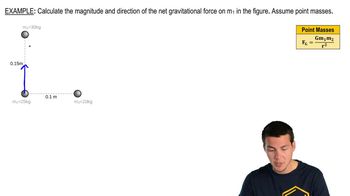
Gravitational force is the attractive force between two masses, described by Newton's law of universal gravitation. It states that the force (F) is directly proportional to the product of the two masses (m1 and m2) and inversely proportional to the square of the distance (r) between their centers, expressed as F = G(m1*m2)/r², where G is the gravitational constant.
Recommended video:
Guided course
05:41
Gravitational Forces in 2D

Gravitational Potential Energy

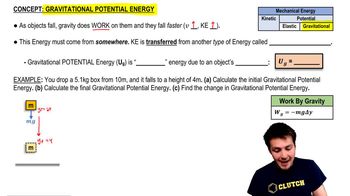
Gravitational potential energy (U) is the energy an object possesses due to its position in a gravitational field. For two masses, it is given by the formula U = -G(m1*m2)/r, indicating that the energy is negative, reflecting the attractive nature of gravity. This energy decreases as the masses come closer together.
Recommended video:
Guided course
06:35
Gravitational Potential Energy

Mass Distribution

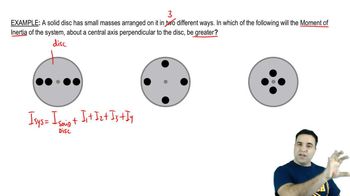
Mass distribution refers to how the total mass of a system is divided among its components. In this problem, the total mass of 400 kg is shared between two spherical objects. To find the individual masses, one can set up equations based on the gravitational force and potential energy, leading to a system of equations that can be solved simultaneously.
Recommended video:
Guided course
03:42
Moment of Inertia & Mass Distribution