Ch 43: Nuclear Physics
Young & Freedman Calc - University Physics 14th Edition
Young & Freedman Calc14th EditionUniversity PhysicsISBN: 9780321973610Not the one you use?Change textbook
Chapter 43, Problem 42

Calculate the energy released in the fusion reaction: 23He+12H24He+11H_2^3He+_1^2H\(\rightarrow\)_2^4He+_1^1H

Verified step by step guidance
1
Step 1: Understand the fusion reaction. Fusion is a process where two lighter nuclei combine to form a heavier nucleus, releasing energy. Identify the specific nuclei involved in the reaction (e.g., hydrogen isotopes like deuterium and tritium).
Step 2: Write the nuclear reaction equation. For example, in the fusion of deuterium (²H) and tritium (³H), the reaction is: H2+H3He4+n. This produces helium-4 and a neutron.
Step 3: Calculate the mass defect. Determine the mass of the reactants (deuterium and tritium) and the products (helium-4 and neutron). Use the equation: ∆m=mreactants-mproducts, where ∆m is the mass defect.
Step 4: Convert the mass defect to energy using Einstein's equation: E=mc^2. Here, m is the mass defect and c is the speed of light (3.00×10^8m/s).
Step 5: Interpret the result. The energy calculated represents the energy released during the fusion reaction. This energy is typically expressed in joules or electron volts (eV).

Verified video answer for a similar problem:

This video solution was recommended by our tutors as helpful for the problem above.
Video duration:
2m
Was this helpful?

Key Concepts

Here are the essential concepts you must grasp in order to answer the question correctly.

Nuclear Fusion

Nuclear fusion is the process where two light atomic nuclei combine to form a heavier nucleus, releasing a significant amount of energy. This reaction powers stars, including our sun, and occurs under extreme temperature and pressure conditions. Understanding fusion is crucial for calculating the energy released in such reactions.
Recommended video:
Guided course
03:55
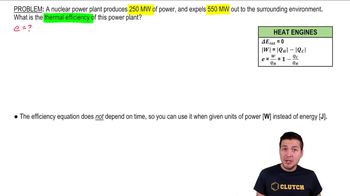
Efficiency of a Nuclear Power Plant

Binding Energy

Binding energy is the energy required to separate a nucleus into its constituent protons and neutrons. It is also the energy released when a nucleus is formed from these particles. The difference in binding energy before and after a fusion reaction determines the energy released, making it a key concept in energy calculations.
Recommended video:
Guided course
04:10
Intro to Energy & Types of Energy

Mass-Energy Equivalence

Mass-energy equivalence, expressed by Einstein's equation E=mc², states that mass can be converted into energy and vice versa. In fusion reactions, a small amount of mass is lost and converted into energy, which is released during the process. This principle is fundamental for understanding how energy is calculated in nuclear reactions.
Recommended video:
Guided course
4:52
Gravitational Potential Energy for Systems of Masses
Related Practice
Textbook Question

In a diagnostic x-ray procedure, 5.00×10105.00\(\times\)10^{10} photons are absorbed by tissue with a mass of 0.6000.600 kg. The x-ray wavelength is 0.0200 0.0200 nm.

(a) What is the total energy absorbed by the tissue?

(b) What is the equivalent dose in rem?

1353
views

Textbook Question

A 6767-kg person accidentally ingests 0.350.35 Ci of tritium.

(a) Assume that the tritium spreads uniformly throughout the body and that each decay leads on the average to the absorption of 5.05.0 keV of energy from the electrons emitted in the decay. The half-life of tritium is 12.312.3 y, and the RBE of the electrons is 1.01.0. Calculate the absorbed dose in rad and the equivalent dose in rem during one week.

(b) The β\(\beta\)^{-} decay of tritium releases more than 5.05.0 keV of energy. Why is the average energy absorbed less than the total energy released in the decay?

1053
views
Textbook Question

It has become popular for some people to have yearly whole-body scans (CT scans, formerly called CAT scans) using x rays, just to see if they detect anything suspicious. A number of medical people have recently questioned the advisability of such scans, due in part to the radiation they impart. Typically, one such scan gives a dose of 1212 mSv, applied to the whole body. By contrast, a chest x ray typically administers 0.200.20 mSv to only 5.05.0 kg of tissue. How many chest x rays would deliver the same total amount of energy to the body of a 7575-kg person as one whole-body scan?

1297
views