
Ch 26: Potential and Field
Knight Calc - Physics for Scientists and Engineers 5th Edition
Knight Calc5th EditionPhysics for Scientists and EngineersISBN: 9780137344796Not the one you use?Change textbook
Chapter 26, Problem 83

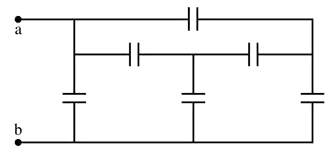
Each capacitor in FIGURE CP26.83 has capacitance C. What is the equivalent capacitance between points a and b?
Schematic diagram of capacitors arranged in series and parallel between points a and b, each with capacitance C.

Verified step by step guidance
1
Step 1: Analyze the circuit diagram. The capacitors are arranged in a combination of series and parallel configurations. Identify the groups of capacitors that are in series and those that are in parallel.
Step 2: For capacitors in series, use the formula for equivalent capacitance: Ceq=11/C1+1/C2. Apply this formula to the capacitors that are connected in series.
Step 3: For capacitors in parallel, use the formula for equivalent capacitance: Ceq=C1+C2. Apply this formula to the capacitors that are connected in parallel.
Step 4: Combine the results from steps 2 and 3 iteratively, simplifying the circuit step by step until you find the total equivalent capacitance between points a and b.
Step 5: Ensure that the final equivalent capacitance is expressed in terms of the given capacitance C, as all capacitors in the circuit have the same capacitance value.

Verified video answer for a similar problem:

This video solution was recommended by our tutors as helpful for the problem above.
Was this helpful?

Key Concepts

Here are the essential concepts you must grasp in order to answer the question correctly.

Capacitance

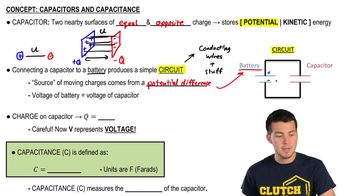
Capacitance is the ability of a capacitor to store electrical charge per unit voltage. It is measured in farads (F) and is defined as the ratio of the charge (Q) stored on one plate to the voltage (V) across the plates, expressed as C = Q/V. Understanding capacitance is crucial for analyzing how capacitors behave in circuits.
Recommended video:
Guided course
08:02
Capacitors & Capacitance (Intro)

Series and Parallel Capacitors

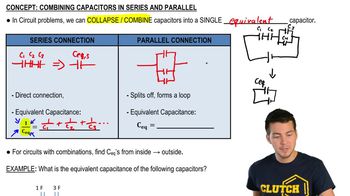
Capacitors can be connected in series or parallel, affecting the total capacitance of the circuit. In series, the total capacitance (C_total) is given by 1/C_total = 1/C1 + 1/C2 + ... for each capacitor, resulting in a lower total capacitance. In parallel, the total capacitance is the sum of individual capacitances: C_total = C1 + C2 + .... This distinction is essential for calculating the equivalent capacitance between points a and b.
Recommended video:
Guided course
09:51
Combining Capacitors in Series & Parallel

Equivalent Capacitance

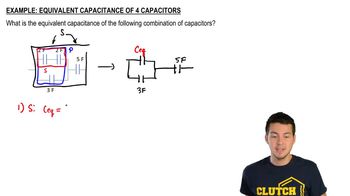
The equivalent capacitance is a single capacitance value that can replace a network of capacitors while maintaining the same electrical behavior. It simplifies circuit analysis by allowing the calculation of total charge and voltage across the network. To find the equivalent capacitance between points a and b, one must apply the rules for series and parallel combinations based on the configuration of the capacitors in the circuit.
Recommended video:
Guided course
03:44
Find Equivalent Capacitance #1