Ch 26: Potential and Field
Knight Calc - Physics for Scientists and Engineers 5th Edition
Knight Calc5th EditionPhysics for Scientists and EngineersISBN: 9780137344796Not the one you use?Change textbook
Chapter 26, Problem 3

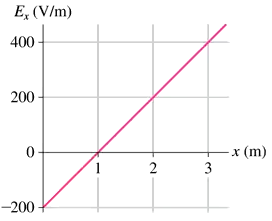
FIGURE EX26.3 is a graph of Ex. What is the potential difference between xi=1.0 m and xf=3.0 m?
Graph of electric field Ex in volts per meter versus position x in meters, showing a linear increase from -200 to 400 V/m.

Verified step by step guidance
1
Identify the relationship between the electric field \( E_x \) and the potential difference \( \Delta V \). The potential difference is given by the integral of the electric field along the path: \( \Delta V = - \int_{x_i}^{x_f} E_x \, dx \).
From the graph provided (FIGURE EX26.3), observe the values of \( E_x \) as a function of \( x \) between \( x_i = 1.0 \; \text{m} \) and \( x_f = 3.0 \; \text{m} \). Note whether \( E_x \) is constant, linear, or varies in another way.
If \( E_x \) is constant over a segment, the integral simplifies to \( \Delta V = -E_x \cdot (x_f - x_i) \). If \( E_x \) varies, divide the interval into smaller segments where \( E_x \) is approximately constant or use the functional form of \( E_x \) to compute the integral.
Evaluate the integral \( \int_{x_i}^{x_f} E_x \, dx \) using the graph. For example, calculate the area under the curve (taking into account the sign of \( E_x \)) between \( x_i = 1.0 \; \text{m} \) and \( x_f = 3.0 \; \text{m} \).
Substitute the result of the integral into \( \Delta V = - \int_{x_i}^{x_f} E_x \, dx \) to find the potential difference. Ensure the correct sign is applied based on the direction of the electric field.

Verified video answer for a similar problem:

This video solution was recommended by our tutors as helpful for the problem above.
Video duration:
3m
Was this helpful?

Key Concepts

Here are the essential concepts you must grasp in order to answer the question correctly.

Electric Field (E)

The electric field (E) is a vector field that represents the force per unit charge experienced by a positive test charge placed in the field. It is defined as the gradient of the electric potential (V) and is measured in volts per meter (V/m). Understanding the electric field is crucial for determining how charges interact and how potential differences arise in a given region.
Recommended video:
Guided course
03:16
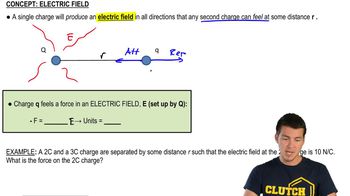
Intro to Electric Fields

Electric Potential (V)

Electric potential (V) is the amount of electric potential energy per unit charge at a specific point in an electric field. It is measured in volts (V) and indicates the work done to move a charge from a reference point to the specified point without any acceleration. The difference in electric potential between two points is what drives the movement of charges, leading to current flow in circuits.
Recommended video:
Guided course
07:33
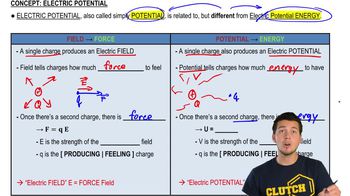
Electric Potential

Potential Difference (ΔV)

Potential difference (ΔV) is the difference in electric potential between two points in an electric field, calculated as ΔV = V_final - V_initial. It represents the work done per unit charge in moving a charge between these two points. In the context of the question, calculating the potential difference between xi=1.0 m and xf=3.0 m involves integrating the electric field over that distance to find the total change in potential.
Recommended video:
Guided course
07:04
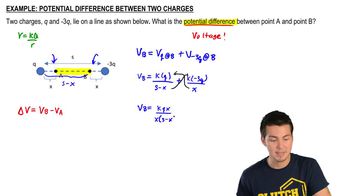
Potential Difference Between Two Charges