Ch 26: Potential and Field
Knight Calc - Physics for Scientists and Engineers 5th Edition
Knight Calc5th EditionPhysics for Scientists and EngineersISBN: 9780137344796Not the one you use?Change textbook
Chapter 26, Problem 5a

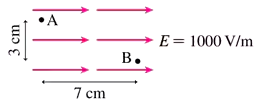
Which point in FIGURE EX26.5, A or B, has a larger electric potential?
Diagram comparing electric potential at points A and B, with arrows indicating electric field direction and strength.

Verified step by step guidance
1
Step 1: Understand the relationship between electric potential and electric field. The electric potential decreases in the direction of the electric field. The formula for the change in electric potential is ΔV = -E * d, where E is the magnitude of the electric field and d is the distance moved in the direction of the field.
Step 2: Analyze the diagram. The electric field is uniform and directed horizontally to the right, with a magnitude of E = 1000 V/m. Points A and B are separated vertically by 3 cm and horizontally by 7 cm.
Step 3: Determine the relative positions of points A and B. Point A is higher vertically, while point B is lower and further to the right. Since the electric field is horizontal, the vertical separation does not affect the electric potential difference.
Step 4: Calculate the horizontal displacement between points A and B. The horizontal distance is 7 cm (0.07 m). Use the formula ΔV = -E * d to find the potential difference due to this displacement. Since point B is further to the right, it is in the direction of the electric field, meaning its potential is lower than point A.
Step 5: Conclude that point A has a larger electric potential than point B because the electric potential decreases in the direction of the electric field, and point B is further along the field direction.

Verified video answer for a similar problem:

This video solution was recommended by our tutors as helpful for the problem above.
Was this helpful?

Key Concepts

Here are the essential concepts you must grasp in order to answer the question correctly.

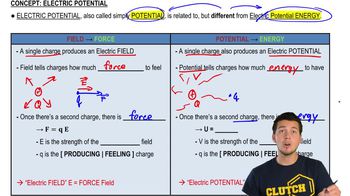
Electric Potential

Electric potential, measured in volts, represents the potential energy per unit charge at a point in an electric field. It indicates how much work is needed to move a charge from a reference point to a specific point within the field. In this context, the electric potential at points A and B can be compared based on their positions relative to the electric field.
Recommended video:
Guided course
07:33
Electric Potential

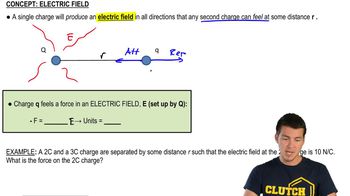
Electric Field

An electric field is a region around a charged object where other charged objects experience a force. It is represented by field lines, with the direction indicating the force on a positive charge. The strength of the electric field (E) is given in volts per meter (V/m) and affects the electric potential at different points within the field.
Recommended video:
Guided course
03:16
Intro to Electric Fields

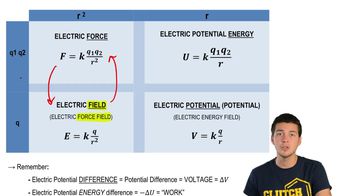
Relationship Between Electric Field and Potential

The relationship between electric field and electric potential is defined by the equation E = -dV/dx, where E is the electric field strength and dV/dx is the change in electric potential over distance. This means that in a uniform electric field, the potential decreases in the direction of the field. Thus, the point closer to the positive charge will have a higher electric potential.
Recommended video:
Guided course
03:43
Relationships Between Force, Field, Energy, Potential