Ch 27: Current and Resistance
Knight Calc - Physics for Scientists and Engineers 5th Edition
Knight Calc5th EditionPhysics for Scientists and EngineersISBN: 9780137344796Not the one you use?Change textbook
Chapter 27, Problem 22

A 0.0075 V/m electric field creates a 3.9 mA current in a 1.0-mm-diameter wire. What material is the wire made of?

Verified step by step guidance
1
Determine the cross-sectional area of the wire. The diameter of the wire is given as 1.0 mm, so the radius is 0.5 mm or 0.0005 m. The cross-sectional area can be calculated using the formula: A=πr2, where r is the radius.
Calculate the current density, J, using the formula: J=IA, where I is the current (3.9 mA or 0.0039 A) and A is the cross-sectional area calculated in the previous step.
Use Ohm's law in its microscopic form to relate the current density to the electric field: J=σE, where σ is the conductivity of the material and E is the electric field (0.0075 V/m). Rearrange this equation to solve for the conductivity: σ=JE.
Once the conductivity is calculated, compare it to known values of conductivity for various materials (e.g., copper, aluminum, etc.) to identify the material of the wire.
Verify the result by checking if the calculated conductivity matches the expected range for the identified material. This ensures the solution is consistent and accurate.

Verified video answer for a similar problem:

This video solution was recommended by our tutors as helpful for the problem above.
Was this helpful?

Key Concepts

Here are the essential concepts you must grasp in order to answer the question correctly.

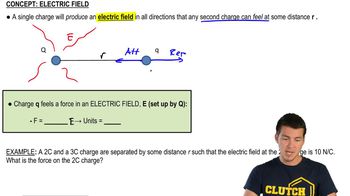
Electric Field

An electric field is a region around a charged particle where a force would be exerted on other charged particles. It is quantified in volts per meter (V/m) and indicates the strength and direction of the force that a charge would experience. In this question, the electric field of 0.0075 V/m is responsible for driving the current through the wire.
Recommended video:
Guided course
03:16
Intro to Electric Fields

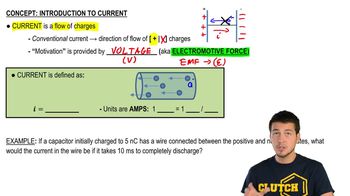
Current

Electric current is the flow of electric charge, typically measured in amperes (A). In this scenario, a current of 3.9 mA (milliamperes) flows through the wire due to the applied electric field. The relationship between current, electric field, and material properties is crucial for determining the wire's conductivity.
Recommended video:
Guided course
05:38
Intro to Current

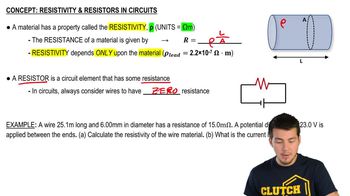
Resistivity

Resistivity is a material property that quantifies how strongly a given material opposes the flow of electric current. It is typically measured in ohm-meters (Ω·m). The resistivity of the wire's material can be calculated using the current, electric field, and the wire's dimensions, allowing us to identify the material based on known resistivity values.
Recommended video:
Guided course
05:25
Resistivity & Resistors in Circuits