Ch 16: Traveling Waves
Knight Calc - Physics for Scientists and Engineers 5th Edition
Knight Calc5th EditionPhysics for Scientists and EngineersISBN: 9780137344796Not the one you use?Change textbook
Chapter 16, Problem 34

A sound wave with intensity 2.0 x 10⁻³ W/m2 is perceived to be modestly loud. Your eardrum is 6.0 mm in diameter. How much energy will be transferred to your eardrum while listening to this sound for 1.0 min?

Verified step by step guidance
1
Understand Chargaff's rule: Chargaff's rule states that in a DNA molecule, the amount of adenine (A) is equal to the amount of thymine (T), and the amount of cytosine (C) is equal to the amount of guanine (G). This is due to the base-pairing nature of DNA, where A pairs with T and C pairs with G.
Recognize the implications of Chargaff's rule: The rule implies that the ratio of purines (adenine and guanine) to pyrimidines (cytosine and thymine) is consistent, and the total number of base pairs in a DNA molecule is always balanced.
Apply Chargaff's rule to analyze DNA composition: If you are given the percentage of one nucleotide, you can use the rule to determine the percentages of the other nucleotides. For example, if adenine makes up 30% of the DNA, thymine will also make up 30%, and cytosine and guanine will each make up 20%.
Evaluate the statements provided in the problem: Identify which statement aligns with the idea of complementary base pairing and the equal proportions of A-T and C-G as described by Chargaff's rule.
Select the statement that best reflects Chargaff's rule: The correct statement will likely involve the relationship between the quantities of adenine, thymine, cytosine, and guanine in a DNA molecule.

Verified video answer for a similar problem:

This video solution was recommended by our tutors as helpful for the problem above.
Video duration:
5m
Was this helpful?

Key Concepts

Here are the essential concepts you must grasp in order to answer the question correctly.

Chargaff's Rule

Chargaff's Rule states that in a double-stranded DNA molecule, the amount of adenine (A) is equal to thymine (T), and the amount of cytosine (C) is equal to guanine (G). This principle is fundamental in understanding the base pairing in DNA, where A pairs with T and C pairs with G, ensuring the stability and integrity of the genetic code.
Recommended video:
Guided course
04:08
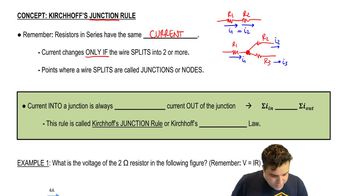
Kirchhoff's Junction Rule

Base Pairing

Base pairing refers to the specific hydrogen bonding between nitrogenous bases in DNA. The complementary nature of base pairing, where A pairs with T and C pairs with G, is crucial for DNA replication and transcription, as it allows for accurate copying of genetic information during cell division.
Recommended video:
Guided course
08:01
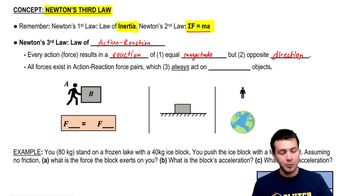
Newton's Third Law & Action-Reaction Pairs

DNA Structure

The structure of DNA is a double helix formed by two strands of nucleotides running in opposite directions. Each nucleotide consists of a sugar, a phosphate group, and a nitrogenous base. Understanding this structure is essential for grasping how Chargaff's Rule applies to the overall stability and function of DNA in biological systems.
Recommended video:
Guided course
05:37
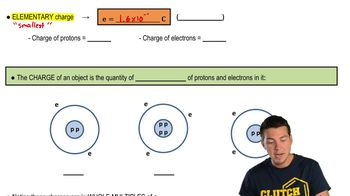
Electric Charge