
Textbook Question
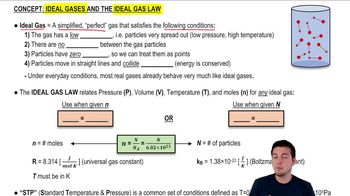
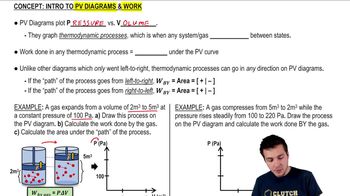
Five moles of an ideal monatomic gas with an initial temperature of °C expand and, in the process, absorb J of heat and do J of work. What is the final temperature of the gas?
2210
views


 Verified step by step guidance
 07:21
07:21
 08:07
08:07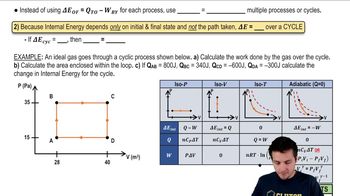 08:45
08:45Five moles of an ideal monatomic gas with an initial temperature of °C expand and, in the process, absorb J of heat and do J of work. What is the final temperature of the gas?
A gas in a cylinder is held at a constant pressure of Pa and is cooled and compressed from m3 to m3. The internal energy of the gas decreases by J. Does it matter whether the gas is ideal? Why or why not?
A gas in a cylinder expands from a volume of m3 to m3 . Heat flows into the gas just rapidly enough to keep the pressure constant at Pa during the expansion. The total heat added is J. Find the work done by the gas.
The -diagram in Fig. E shows a process involving mol of an ideal gas. How much heat had to be added during the process to increase the internal energy of the gas by J?
Figure E shows a -diagram for an ideal gas in which its absolute temperature at is one-fourth of its absolute temperature at . Did heat enter or leave the gas from to ? How do you know?
When water is boiled at a pressure of atm, the heat of vaporization is J/kg and the boiling point is °C. At this pressure, kg of water has a volume of m3, and kg of steam has a volume of m3. Compute the work done when kg of steam is formed at this temperature.