
Ch 25: The Electric Potential
Knight Calc - Physics for Scientists and Engineers 5th Edition
Knight Calc5th EditionPhysics for Scientists and EngineersISBN: 9780137344796Not the one you use?Change textbook
Chapter 25, Problem 59

A 2.0-cm-diameter copper ring has 5.0×10⁹ excess electrons. A proton is released from rest on the axis of the ring, 5.0 cm from its center. What is the proton's speed as it passes through the center of the ring?

Verified step by step guidance
1
Determine the total charge on the copper ring due to the excess electrons. Use the formula for charge: \( Q = n \cdot e \), where \( n \) is the number of excess electrons and \( e \) is the elementary charge (\( e = 1.6 \times 10^{-19} \; \text{C} \)).
Calculate the electric potential at the center of the ring due to the charge on the ring. The formula for the electric potential at the center of a ring is \( V = \frac{k \cdot Q}{R} \), where \( k \) is Coulomb's constant (\( k = 8.99 \times 10^9 \; \text{N·m}^2/\text{C}^2 \)) and \( R \) is the radius of the ring (half the diameter).
Determine the initial electric potential energy of the proton when it is 5.0 cm away from the center of the ring. Use the formula \( U = q \cdot V \), where \( q \) is the charge of the proton (\( q = 1.6 \times 10^{-19} \; \text{C} \)) and \( V \) is the electric potential at that point. The potential at a distance \( x \) from the center of the ring can be calculated using \( V = \frac{k \cdot Q}{\sqrt{R^2 + x^2}} \).
Apply the principle of conservation of energy. The initial electric potential energy of the proton is converted into its kinetic energy as it passes through the center of the ring. Use the equation \( U_{\text{initial}} = K_{\text{final}} \), where \( K_{\text{final}} = \frac{1}{2} m v^2 \), \( m \) is the mass of the proton (\( m = 1.67 \times 10^{-27} \; \text{kg} \)), and \( v \) is the speed of the proton.
Solve for the speed \( v \) of the proton by rearranging the kinetic energy equation: \( v = \sqrt{\frac{2 \cdot U_{\text{initial}}}{m}} \). Substitute the values for \( U_{\text{initial}} \) and \( m \) to find the proton's speed as it passes through the center of the ring.

Verified video answer for a similar problem:

This video solution was recommended by our tutors as helpful for the problem above.
Was this helpful?

Key Concepts

Here are the essential concepts you must grasp in order to answer the question correctly.

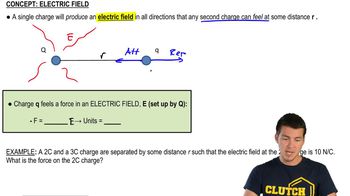
Electric Field

The electric field is a vector field surrounding charged particles that exerts a force on other charged objects. It is defined as the force per unit charge experienced by a positive test charge placed in the field. In this scenario, the excess electrons in the copper ring create an electric field that influences the motion of the proton as it moves towards the center.
Recommended video:
Guided course
03:16
Intro to Electric Fields

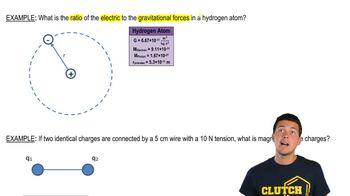
Coulomb's Law

Coulomb's Law describes the force between two point charges. It states that the force is directly proportional to the product of the magnitudes of the charges and inversely proportional to the square of the distance between them. This law is essential for calculating the force acting on the proton due to the electric field created by the excess electrons in the ring.
Recommended video:
Guided course
09:52
Coulomb's Law

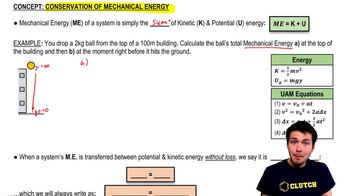
Conservation of Energy

The principle of conservation of energy states that energy cannot be created or destroyed, only transformed from one form to another. In this problem, the potential energy of the proton in the electric field is converted into kinetic energy as it accelerates towards the center of the ring. This relationship allows us to calculate the proton's speed as it passes through the center.
Recommended video:
Guided course
06:24
Conservation Of Mechanical Energy
Related Practice
Textbook Question

Two 10-cm-diameter electrodes 0.50 cm apart form a parallel-plate capacitor. The electrodes are attached by metal wires to the terminals of a 15 V battery. After a long time, the capacitor is disconnected from the battery but is not discharged. What are the charge on each electrode, the electric field strength inside the capacitor, and the potential difference between the electrodes after the original electrodes (not the modified electrodes of part b) are expanded until they are 20 cm in diameter?

1772
views
Textbook Question

A proton is fired from far away toward the nucleus of an iron atom. Iron is element number 26, and the diameter of the nucleus is 9.0 fm. What initial speed does the proton need to just reach the surface of the nucleus? Assume the nucleus remains at rest.

110
views
Textbook Question

Electrodes of area A are spaced distance d apart to form a parallel-plate capacitor. The electrodes are charged to ±q. What is the infinitesimal increase in electric potential energy dU if an infinitesimal amount of charge dq is moved from the negative electrode to the positive electrode?

141
views
Textbook Question

The potential 1.0 cm from the surface of a metal sphere is 8000 V. The potential 3.0 cm from the surface is 4000 V. What is the radius of the sphere?

142
views
Textbook Question

In the form of radioactive decay known as alpha decay, an unstable nucleus emits a helium-atom nucleus, which is called an alpha particle. An alpha particle contains two protons and two neutrons, thus having mass m=4 u and charge q=2e. Suppose a uranium nucleus with 92 protons decays into thorium, with 90 protons, and an alpha particle. The alpha particle is initially at rest at the surface of the thorium nucleus, which is 15 fm in diameter. What is the speed of the alpha particle when it is detected in the laboratory? Assume the thorium nucleus remains at rest.

112
views
Textbook Question

A 2.0-mm-diameter glass bead is positively charged. The potential difference between a point 2.0 mm from the bead and a point 4.0 mm from the bead is 500 V. What is the charge on the bead?

207
views