
Ch. 17 - Temperature, Thermal Expansion, and the Ideal Gas Law
Giancoli Douglas - Physics for Scientists and Engineers 5th edition
Giancoli Douglas5th editionPhysics for Scientists and EngineersISBN: 9780137488179Not the one you use?Change textbook
Chapter 17, Problem 15

An aluminum sphere is 8.75 cm in diameter. What will be its % change in volume if it is heated from 30°C to 140°C?

Verified step by step guidance
1
Determine the formula for the volume of a sphere: \( V = \frac{4}{3} \pi r^3 \), where \( r \) is the radius of the sphere. The diameter is given as 8.75 cm, so calculate the radius as \( r = \frac{8.75}{2} \) cm.
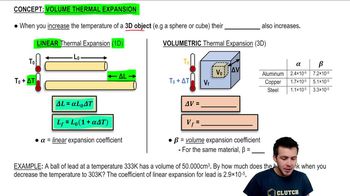
The volume change due to thermal expansion can be calculated using the formula \( \Delta V = \beta V_0 \Delta T \), where \( \beta \) is the coefficient of volumetric expansion for aluminum, \( V_0 \) is the initial volume, and \( \Delta T \) is the temperature change.
Find the initial volume \( V_0 \) by substituting the radius into the sphere volume formula: \( V_0 = \frac{4}{3} \pi r^3 \).
Calculate the temperature change \( \Delta T = T_{\text{final}} - T_{\text{initial}} = 140^{\circ}C - 30^{\circ}C \). Use the given temperature values.
Substitute \( \beta \), \( V_0 \), and \( \Delta T \) into the formula \( \Delta V = \beta V_0 \Delta T \) to find the change in volume. Then, calculate the percentage change in volume using \( \%\,\Delta V = \frac{\Delta V}{V_0} \times 100 \).

Verified video answer for a similar problem:

This video solution was recommended by our tutors as helpful for the problem above.
Video duration:
3m
Was this helpful?

Key Concepts

Here are the essential concepts you must grasp in order to answer the question correctly.

Thermal Expansion

Thermal expansion refers to the increase in volume of a material as its temperature rises. For solids, liquids, and gases, this phenomenon occurs due to the increased kinetic energy of particles, causing them to move apart. The degree of expansion can be quantified using the coefficient of volumetric expansion, which varies by material.
Recommended video:
Guided course
05:21
Volume Thermal Expansion

Volume of a Sphere

The volume of a sphere is calculated using the formula V = (4/3)πr³, where r is the radius. In this case, the radius can be determined from the diameter provided. Understanding how to calculate the volume is essential for determining the change in volume due to thermal expansion.
Recommended video:
Guided course
05:21
Volume Thermal Expansion

Percentage Change in Volume

Percentage change in volume is calculated by taking the difference between the final and initial volumes, dividing by the initial volume, and then multiplying by 100. This metric allows for a clear understanding of how much the volume has increased relative to its original size, which is crucial for interpreting the effects of temperature changes.
Recommended video:
Guided course
05:21
Volume Thermal Expansion
Related Practice
Textbook Question

It is observed that 55.50 mL of water at 20°C completely fills a container to the brim. When the container and the water are heated to 60°C, 0.35 g of water is lost.

(a) What is the coefficient of volume expansion of the container?

(b) What is the most likely material of the container? Density of water at 60°C is 0.98324 g/mL.

1019
views
Textbook Question

A glass is filled to the brim with 450.0 mL of water, all at 100.0°C. If the temperature of glass and water is decreased to 20.0°C, how much water could be added to the glass?

977
views
Textbook Question

A uniform rectangular plate of length ℓ and width ω has a coefficient of linear expansion α. Show that, if we neglect very small quantities, the change in area of the plate due to a temperature change ∆T is ∆A = 2αℓω ∆T. See Fig. 17–21.

816
views
Textbook Question

The Eiffel Tower (Fig. 17–20) is built of wrought iron approximately 300 m tall. Estimate how much its height changes between January (average temperature of 2°C) and July (average temperature of 25°C). Ignore the angles of the iron beams and treat the tower as a vertical beam.

<IMAGE>

1121
views
Textbook Question

The density of water at 4°C is 1.00 x 10³ kg / m³. What is water’s density at 94°C? Assume a constant coefficient of volume expansion.

1522
views
Textbook Question

At a given latitude, ocean water in the so-called mixed layer (from the surface to a depth of about 50 m) is at approximately the same temperature due to the mixing action of waves. Assume that because of global warming, the temperature of the mixed layer is everywhere increased by 0.5°C, while the temperature of the deeper portions of the ocean remains unchanged. Estimate the resulting rise in sea level. The ocean covers about 70% of the Earth’s surface.

983
views