Ch 35: Optical Instruments
Knight Calc - Physics for Scientists and Engineers 5th Edition
Knight Calc5th EditionPhysics for Scientists and EngineersISBN: 9780137344796Not the one you use?Change textbook
Chapter 35, Problem 23

Infrared telescopes, which use special infrared detectors, are able to peer farther into star-forming regions of the galaxy because infrared light is not scattered as strongly as is visible light by the tenuous clouds of hydrogen gas from which new stars are created. For what wavelength of light is the scattering only 1% that of light with a visible wavelength of 500 nm?

Verified step by step guidance
1
Understand the relationship between scattering and wavelength: Scattering intensity is inversely proportional to the fourth power of the wavelength, as described by Rayleigh scattering. This means that if the wavelength increases, the scattering decreases significantly.
Express the relationship mathematically: The ratio of scattering intensities for two wavelengths can be written as \( \frac{I_1}{I_2} = \left( \frac{\lambda_2}{\lambda_1} \right)^4 \), where \( I_1 \) and \( I_2 \) are the scattering intensities, and \( \lambda_1 \) and \( \lambda_2 \) are the wavelengths.
Substitute the given values: The problem states that the scattering intensity at the unknown wavelength \( \lambda_2 \) is 1% of the scattering intensity at \( \lambda_1 = 500 \, \text{nm} \). This means \( \frac{I_2}{I_1} = 0.01 \). Rearrange the formula to solve for \( \lambda_2 \): \( \lambda_2 = \lambda_1 \cdot \left( \frac{I_1}{I_2} \right)^{1/4} \).
Plug in the numerical values: Substitute \( \lambda_1 = 500 \, \text{nm} \) and \( \frac{I_1}{I_2} = 100 \) (since \( \frac{I_2}{I_1} = 0.01 \) implies \( \frac{I_1}{I_2} = 1/0.01 = 100 \)) into the equation \( \lambda_2 = 500 \cdot 100^{1/4} \).
Simplify the expression: Calculate \( 100^{1/4} \), which is the fourth root of 100, and multiply it by 500 nm to find the wavelength \( \lambda_2 \). This will give the wavelength where the scattering is only 1% of that at 500 nm.

Verified video answer for a similar problem:

This video solution was recommended by our tutors as helpful for the problem above.
Was this helpful?

Key Concepts

Here are the essential concepts you must grasp in order to answer the question correctly.

Scattering of Light

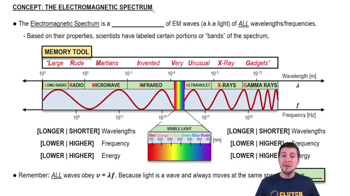
Scattering of light refers to the process by which light is redirected in various directions when it encounters particles or irregularities in a medium. The extent of scattering depends on the wavelength of the light and the size of the particles. Shorter wavelengths, like visible light, tend to scatter more than longer wavelengths, such as infrared light, making infrared telescopes more effective in observing distant astronomical objects obscured by gas and dust.
Recommended video:
10:30
Ray Nature of Light

Wavelength and Energy of Light

The wavelength of light is the distance between successive peaks of a wave, and it is inversely related to the energy of the light. Shorter wavelengths correspond to higher energy photons, while longer wavelengths correspond to lower energy photons. In the context of the question, understanding how wavelength affects scattering helps determine the specific wavelength at which scattering is reduced to 1% of that at 500 nm.
Recommended video:
10:30
Ray Nature of Light

Infrared Astronomy

Infrared astronomy involves the observation of celestial objects in the infrared spectrum, which is beyond the visible range of light. Infrared telescopes are designed to detect this type of radiation, allowing astronomers to study cooler objects, such as star-forming regions and dust clouds, that are often obscured in visible light. This capability is crucial for understanding the formation and evolution of stars and galaxies.
Recommended video:
Guided course
06:06
The Electromagnetic Spectrum
Related Practice