Ch 19: Work, Heat, and the First Law of Thermodynamics
Knight Calc - Physics for Scientists and Engineers 5th Edition
Knight Calc5th EditionPhysics for Scientists and EngineersISBN: 9780137344796Not the one you use?Change textbook
Chapter 19, Problem 17

One way you keep from overheating is by perspiring. Evaporation—a phase change—requires heat, and the heat energy is removed from your body. Evaporation is much like boiling, only water's heat of vaporization at 35°C is a somewhat larger 24×105 J/kg because at lower temperatures more energy is required to break the molecular bonds. Very strenuous activity can cause an adult human to produce 30 g of perspiration per minute. If all the perspiration evaporates, rather than dripping off, at what rate (in J/s) is it possible to exhaust heat by perspiring?

Verified step by step guidance
1
Step 1: Understand the problem. The goal is to calculate the rate at which heat is exhausted by perspiration. This involves using the heat of vaporization of water and the mass of perspiration evaporated per unit time.
Step 2: Convert the given mass of perspiration per minute into kilograms per second. Since 1 gram = 0.001 kilograms, and there are 60 seconds in a minute, the mass flow rate in kg/s can be calculated as \( \text{mass flow rate} = \frac{30 \text{ g}}{60 \text{ s}} \times 0.001 \text{ kg/g} \).
Step 3: Use the formula for heat transfer during phase change: \( Q = m \cdot L \), where \( Q \) is the heat energy, \( m \) is the mass, and \( L \) is the heat of vaporization. Here, \( L \) is given as \( 24 \times 10^5 \text{ J/kg} \).
Step 4: To find the rate of heat exhaustion (power), divide the heat energy \( Q \) by the time \( t \). Since \( Q \) is calculated per second, the rate of heat exhaustion is \( P = m \cdot L \), where \( m \) is the mass flow rate in kg/s.
Step 5: Substitute the values for \( m \) and \( L \) into the formula \( P = m \cdot L \) to calculate the rate of heat exhaustion in \( \text{J/s} \). Ensure all units are consistent (kg, J, s).

Key Concepts

Here are the essential concepts you must grasp in order to answer the question correctly.

Evaporation and Heat of Vaporization

Evaporation is the process where liquid turns into vapor, requiring energy to overcome intermolecular forces. The heat of vaporization is the amount of energy needed to convert a unit mass of liquid into vapor at a constant temperature. For water at 35°C, this value is approximately 24×10^5 J/kg, indicating that significant energy is absorbed during the phase change, which helps cool the body when perspiration evaporates.
Recommended video:
Guided course
05:00
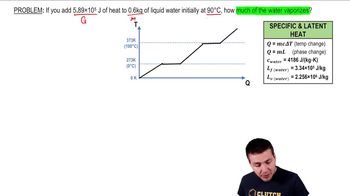
Finding Amount of Water Vaporized

Perspiration and Cooling Mechanism

Perspiration is the process of secreting sweat from sweat glands, which primarily consists of water. When sweat evaporates from the skin's surface, it absorbs heat from the body, effectively cooling it down. This mechanism is crucial during physical exertion, as it helps maintain a stable body temperature by dissipating excess heat generated from metabolic processes.
Recommended video:
Guided course
06:46
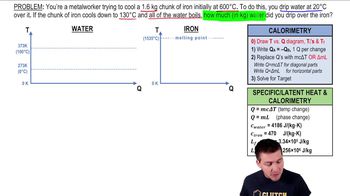
Cooling a Chunk of Iron

Rate of Heat Exhaustion Calculation

To calculate the rate of heat exhaustion through perspiration, one can use the formula: power (in watts) equals the mass of perspiration (in kg) multiplied by the heat of vaporization (in J/kg) divided by time (in seconds). Given that an adult can produce 30 g of sweat per minute, converting this to kg and applying the heat of vaporization allows for determining the energy exhausted per second, which is essential for understanding the cooling effect of sweating.
Recommended video:
Guided course
07:27
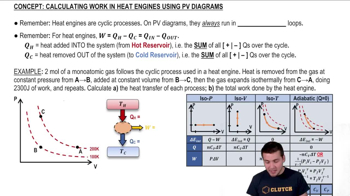
Calculating Work in Heat Engines Using PV Diagrams