
An electron is in a box of width 3.0*10^-10 m. What are the de Broglie wavelength and the magnitude of the momentum of the electron if it is in (a) the n = 1 level; (b) the n = 2 level; (c) the n = 3 level? In each case how does the wavelength compare to the width of the box?
Ch 40: Quantum Mechanics I: Wave Functions
Young & Freedman Calc14th EditionUniversity PhysicsISBN: 9780321973610Not the one you use?Change textbook
All textbooks
Young & Freedman Calc 14th Edition
Ch 40: Quantum Mechanics I: Wave Functions
Problem 40.2c
Young & Freedman Calc 14th Edition
Ch 40: Quantum Mechanics I: Wave Functions
Problem 40.2cChapter 40, Problem 40.2c
A free particle moving in one dimension has wave function ψ(x,t) = A[e^i(kx-ωt) -e^i(2kx-4ωt)] where k and v are positive real constants. (c) Calculate v_av as the distance the maxima have moved divided by the elapsed time.
Verified step by step guidance1
First, identify the wave function given: ψ(x,t) = A[e^(i(kx-ωt)) - e^(i(2kx-4ωt))]. This represents a superposition of two waves with different wave numbers and angular frequencies.
To find the maxima, consider the condition for constructive interference, which occurs when the phase difference between the two waves is an integer multiple of 2π. This means setting the argument of the exponentials equal to each other modulo 2π.
Calculate the phase difference between the two waves: Δφ = (2kx - 4ωt) - (kx - ωt) = kx - 3ωt. Set Δφ = 2πn, where n is an integer, to find the positions of maxima.
Solve for x in terms of t: kx - 3ωt = 2πn implies x = (2πn + 3ωt)/k. This equation gives the position of the maxima as a function of time.
The average velocity v_av of the maxima is the change in position divided by the change in time. Use the expression for x to find v_av: v_av = (d/dt)[(2πn + 3ωt)/k] = 3ω/k.

Verified video answer for a similar problem:
This video solution was recommended by our tutors as helpful for the problem above.
Video duration:
14mWas this helpful?
Key Concepts
Here are the essential concepts you must grasp in order to answer the question correctly.
Wave Function
A wave function, denoted as ψ(x,t), describes the quantum state of a particle in terms of its position and time. It contains all the information about the system and is used to calculate probabilities of finding a particle in a particular state. In this context, the wave function is a superposition of two waves, indicating interference effects.
Recommended video:
Guided course
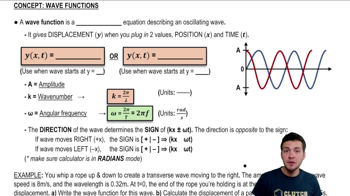
Intro to Wave Functions
Superposition Principle
The superposition principle states that if two or more wave functions are solutions to a linear wave equation, their sum is also a solution. This principle is crucial in quantum mechanics, as it allows for the combination of multiple states, leading to interference patterns. In the given wave function, the superposition of two waves results in a complex pattern of maxima and minima.
Recommended video:
Guided course
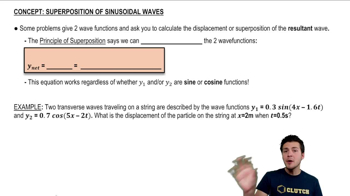
Superposition of Sinusoidal Wave Functions
Phase Velocity
Phase velocity is the rate at which the phase of the wave propagates in space. It is given by the formula v_p = ω/k, where ω is the angular frequency and k is the wave number. In the context of the problem, understanding phase velocity helps in determining how the maxima of the wave function move over time, which is essential for calculating the average velocity v_av.
Recommended video:
Guided course
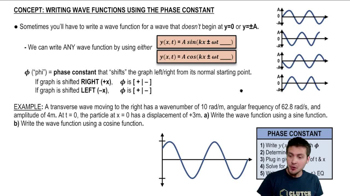
Phase Constant of a Wave Function
Related Practice
Textbook Question
47
views
Textbook Question
For the ground level of a harmonic oscillator, . Do a similar analysis for an excited level that has quantum number . How does the uncertainty product depend on ?
95
views
Textbook Question
While undergoing a transition from the to the energy level, a harmonic oscillator absorbs a photon of wavelength m. What is the wavelength of the absorbed photon when this oscillator undergoes a transition (a) from the to the energy level and (b) from the to the energy level?
(c) What is the value of , the angular oscillation frequency of the corresponding Newtonian oscillator?
55
views