
Ch 14: Fluids and Elasticity
Knight Calc - Physics for Scientists and Engineers 5th Edition
Knight Calc5th EditionPhysics for Scientists and EngineersISBN: 9780137344796Not the one you use?Change textbook
Chapter 14, Problem 28

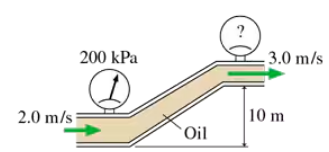
What does the top pressure gauge read in FIGURE EX14.28?

Verified step by step guidance
1
Analyze the physical setup in FIGURE EX14.28. Identify the components of the system, such as the fluid type, the height difference between the gauges, and any external forces acting on the fluid (e.g., gravity).
Recall the principle of fluid pressure: Pressure at a given depth in a fluid is determined by the equation: P=Patm+ρgh, where Patm is atmospheric pressure, ρ is the fluid density, g is the acceleration due to gravity, and h is the height of the fluid column.
Determine the pressure at the bottom gauge using the above formula. If the bottom gauge is at a depth h below the top gauge, calculate the pressure difference caused by the fluid column between the two gauges.
Use the pressure difference to calculate the reading on the top pressure gauge. Subtract the pressure contribution of the fluid column (ρgh) from the bottom gauge reading to find the top gauge pressure.
Verify your result by considering any additional factors, such as whether the fluid is open to the atmosphere or enclosed, and ensure consistency with the physical principles of fluid mechanics.

Verified video answer for a similar problem:

This video solution was recommended by our tutors as helpful for the problem above.
Video duration:
3m
Was this helpful?

Key Concepts

Here are the essential concepts you must grasp in order to answer the question correctly.

Pressure Measurement

Pressure is defined as the force exerted per unit area. In fluid mechanics, pressure gauges are used to measure the pressure of fluids in a system. Understanding how pressure is measured and the units involved (such as pascals or atmospheres) is essential for interpreting gauge readings accurately.
Recommended video:
Guided course
17:04
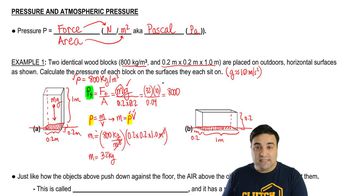
Pressure and Atmospheric Pressure

Hydrostatic Pressure

Hydrostatic pressure refers to the pressure exerted by a fluid at rest due to the weight of the fluid above it. This concept is crucial when analyzing pressure in a fluid column, as it increases with depth. The hydrostatic pressure can be calculated using the formula P = ρgh, where ρ is the fluid density, g is the acceleration due to gravity, and h is the height of the fluid column.
Recommended video:
Guided course
17:04
Pressure and Atmospheric Pressure

Gauge Pressure vs. Absolute Pressure

Gauge pressure is the pressure relative to atmospheric pressure, while absolute pressure is the total pressure measured from a perfect vacuum. Understanding the difference is important when interpreting pressure gauge readings, as some gauges display gauge pressure, which can lead to confusion if absolute pressure is required for calculations or comparisons.
Recommended video:
Guided course
09:27
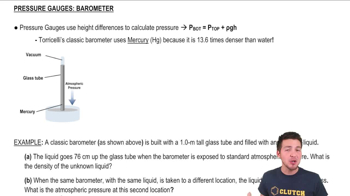
Pressure Gauges: Barometer