
Ch 24: Gauss' Law
Knight Calc - Physics for Scientists and Engineers 5th Edition
Knight Calc5th EditionPhysics for Scientists and EngineersISBN: 9780137344796Not the one you use?Change textbook
Chapter 24, Problem 59b

A sphere of radius R has total charge Q. The volume charge density (C/m³) within the sphere is p(r) = C/r², where C is a constant to be determined. Use Gauss’s law to find an expression for the electric field strength E inside the sphere, r ≤ R, in terms of Q and R.

Verified step by step guidance
1
Step 1: Start by recalling Gauss's law, which states that the electric flux through a closed surface is proportional to the enclosed charge: ∮E·dA = Q_enclosed/ε₀. For a sphere, the symmetry simplifies the electric field to be radial, so E is constant over the Gaussian surface.
Step 2: Define a Gaussian surface as a sphere of radius r (where r ≤ R) inside the charged sphere. The electric flux through this surface is given by Φ = E·(4πr²), where 4πr² is the surface area of the sphere.
Step 3: Calculate the enclosed charge Q_enclosed within the Gaussian surface. The charge density is given as p(r) = C/r². To find Q_enclosed, integrate the charge density over the volume of the sphere up to radius r: Q_enclosed = ∫₀ʳ p(r)·4πr²·dr = ∫₀ʳ (C/r²)·4πr²·dr.
Step 4: Simplify the integral for Q_enclosed. Substitute p(r) = C/r² and integrate: Q_enclosed = ∫₀ʳ 4πC·dr = 4πC·r. This gives the enclosed charge as a function of radius r.
Step 5: Substitute Q_enclosed into Gauss's law to find the electric field E. Using Φ = E·(4πr²) = Q_enclosed/ε₀, solve for E: E = (Q_enclosed)/(4πr²ε₀). Replace Q_enclosed with the expression derived in Step 4 to express E in terms of r, Q, and R.

Verified video answer for a similar problem:

This video solution was recommended by our tutors as helpful for the problem above.
Video duration:
10m
Was this helpful?

Key Concepts

Here are the essential concepts you must grasp in order to answer the question correctly.

Gauss's Law

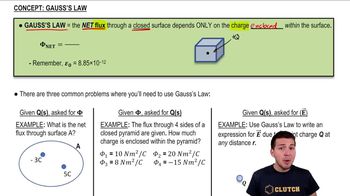
Gauss's Law relates the electric flux through a closed surface to the charge enclosed by that surface. Mathematically, it states that the total electric flux Φ through a closed surface is equal to the enclosed charge Q_enc divided by the permittivity of free space ε₀. This principle is fundamental in electrostatics and is particularly useful for calculating electric fields in symmetric charge distributions.
Recommended video:

Electric Field Strength

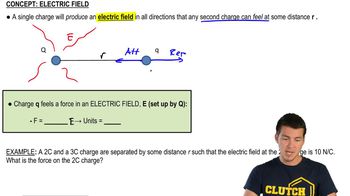
Electric field strength (E) is a vector quantity that represents the force experienced by a unit positive charge placed in an electric field. It is defined as the force per unit charge and is measured in newtons per coulomb (N/C). The electric field can vary with position, especially in the presence of charge distributions, and is crucial for understanding how charges interact with each other.
Recommended video:
Guided course
03:16
Intro to Electric Fields

Volume Charge Density

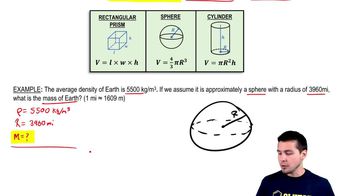
Volume charge density (ρ) is a measure of the amount of electric charge per unit volume within a given region of space. It is expressed in coulombs per cubic meter (C/m³). In this problem, the volume charge density varies with the distance from the center of the sphere, which affects the calculation of the total charge enclosed within a Gaussian surface and subsequently influences the electric field strength derived from Gauss's Law.
Recommended video:
Guided course
04:33
Problems with Mass, Volume, & Density
Related Practice
Textbook Question

An infinite cylinder of radius R has a linear charge density λ . The volume charge density (C/m³) within the cylinder (r ≤ R ) is p (r) = rp₀ / R, where p₀ is a constant to be determined. The charge within a small volume dV is dq = pdV. The integral of pdV over a cylinder of length L is the total charge Q = λL within the cylinder. Use this fact to show that p₀ = 3λ / 2πR² Hint: Let dV be a cylindrical shell of length L, radius r, and thickness dr. What is the volume of such a shell?

2017
views
Textbook Question

A spherical ball of charge has radius R and total charge Q. The electric field strength inside the ball (r ≤ R ) is E(r)=r4Emax/R4E(r)=r^4E_{max}/R^4. Find an expression for the volume charge density ρ(r) inside the ball as a function of r.

1867
views
Textbook Question

An infinite cylinder of radius R has a linear charge density λ. The volume charge density (C/m3) within the cylinder (r ≤ R) is p(r)=rp0/Rp(r) = rp_0 / R, where p₀ is a constant to be determined. Use Gauss’s law to find an expression for the electric field strength E inside the cylinder, r ≤ R, in terms of λ and R.

137
views
Textbook Question

All examples of Gauss’s law have used highly symmetric surfaces where the flux integral is either zero or EA. Yet we’ve claimed that the net Φe=Qin/ϵ0\(\Phi\)_{e}=Q_{in}/\(\epsilon\)_0 is independent of the surface. This is worth checking. FIGURE CP24.57 shows a cube of edge length L centered on a long thin wire with linear charge density λ. The flux through one face of the cube is not simply EA because, in this case, the electric field varies in both strength and direction. But you can calculate the flux by actually doing the flux integral. Show that the net flux through the cube is Φe=Qin/ϵ0\(\Phi\)_{e}=Q_{in}/\(\epsilon\)_0.

192
views