Ch 18: A Macroscopic Description of Matter
Knight Calc - Physics for Scientists and Engineers 5th Edition
Knight Calc5th EditionPhysics for Scientists and EngineersISBN: 9780137344796Not the one you use?Change textbook
Chapter 18, Problem 27a

A gas with initial state variables p1, V1, and T1 is cooled in an isochoric process until p2 = (1/3)p1. What are V2?

Verified step by step guidance
1
Step 1: Understand the problem. An isochoric process means the volume remains constant throughout the process. Therefore, V₂ = V₁. This is a key property of isochoric processes.
Step 2: Recall the ideal gas law, which is given by: pV=nRT. Since the volume (V) is constant, we can write the relationship between pressure and temperature as: pT=\(\text{constant}\).
Step 3: Use the given condition that p2= rac{1}{3}p1. Substitute this into the proportionality derived from the ideal gas law: p1T1=p2T2.
Step 4: Rearrange the equation to solve for T2: T2=p2T1p1. Substitute p2= rac{1}{3}p1 into the equation.
Step 5: Simplify the expression for T2 to find its relationship with T1. Since the volume remains constant, the final volume V2 is equal to the initial volume V1.

Verified video answer for a similar problem:

This video solution was recommended by our tutors as helpful for the problem above.
Video duration:
2m
Was this helpful?

Key Concepts

Here are the essential concepts you must grasp in order to answer the question correctly.

Isochoric Process

An isochoric process is a thermodynamic process in which the volume of the system remains constant. During this process, any change in temperature or pressure occurs without any work being done on or by the system, as work is defined as force applied over a distance. This characteristic is crucial for understanding how pressure and temperature relate when volume does not change.
Recommended video:
Guided course
08:45
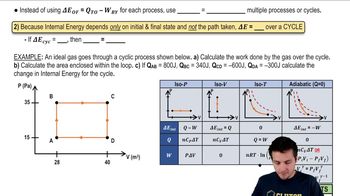
Properties of Cyclic Thermodynamic Processes

Ideal Gas Law

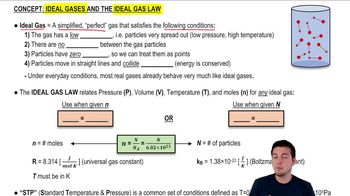
The Ideal Gas Law is a fundamental equation in thermodynamics that relates pressure (p), volume (V), temperature (T), and the number of moles (n) of a gas. It is expressed as PV = nRT, where R is the ideal gas constant. This law allows us to predict how changes in one state variable affect the others, particularly useful in analyzing the behavior of gases during various processes.
Recommended video:
Guided course
07:21
Ideal Gases and the Ideal Gas Law

Charles's Law

Charles's Law states that the volume of a gas is directly proportional to its absolute temperature when pressure is held constant. In the context of an isochoric process, while the volume remains unchanged, understanding this law helps clarify how temperature and pressure interact. Since the volume does not change, a decrease in temperature will lead to a corresponding decrease in pressure, as indicated in the problem.
Recommended video: