
Pearson+ LogoPearson+ Logo
Ch 02: Kinematics in One Dimension
Knight Calc - Physics for Scientists and Engineers 5th Edition
Knight Calc5th EditionPhysics for Scientists and EngineersISBN: 9780137344796Not the one you use?Change textbook
Chapter 2, Problem 4c

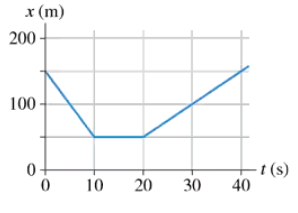
FIGURE EX2.4 is the position-versus-time graph of a bicycle. What is the bicycle's velocity at t = 30s?

Verified step by step guidance
1
Step 1: Understand the concept of velocity. Velocity is the rate of change of position with respect to time. For a position-versus-time graph, the velocity at a specific time is determined by finding the slope of the tangent line to the graph at that time.
Step 2: Locate the point on the graph corresponding to t = 30s. Identify the position of the bicycle at this time by reading the graph carefully.
Step 3: Draw a tangent line to the curve at t = 30s. The tangent line represents the instantaneous rate of change of position at that specific time.
Step 4: Calculate the slope of the tangent line. The slope is given by the formula: yx, where Δy is the change in position and Δx is the change in time. Choose two points on the tangent line and compute the slope using this formula.
Step 5: Interpret the slope value. The slope of the tangent line at t = 30s gives the velocity of the bicycle at that specific time. Ensure the units are consistent (e.g., meters per second) and reflect the physical meaning of the graph.

Verified video answer for a similar problem:

This video solution was recommended by our tutors as helpful for the problem above.
Video duration:
2m
Was this helpful?

Key Concepts

Here are the essential concepts you must grasp in order to answer the question correctly.

Position vs. Time Graph

A position vs. time graph visually represents an object's position over time. The x-axis typically denotes time, while the y-axis shows position. The slope of the graph at any point indicates the object's velocity, with a steeper slope corresponding to a higher velocity.
Recommended video:
Guided course
03:04
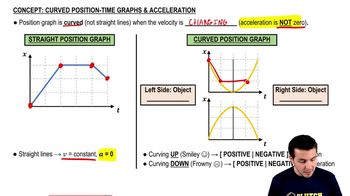
Curved Position-Time Graphs & Acceleration

Velocity

Velocity is a vector quantity that describes the rate of change of an object's position with respect to time. It includes both speed and direction. In the context of a position vs. time graph, velocity can be determined by calculating the slope of the graph at a specific time point.
Recommended video:
Guided course
7:27
Escape Velocity

Calculating Slope

The slope of a line on a graph is calculated by taking the change in the y-values divided by the change in the x-values (rise over run). For a position vs. time graph, this calculation gives the velocity of the object. At t = 30s, identifying the coordinates of the graph at that time allows for the determination of the slope and thus the velocity.
Recommended video: