
Ch 04: Kinematics in Two Dimensions
Chapter 4, Problem 63a

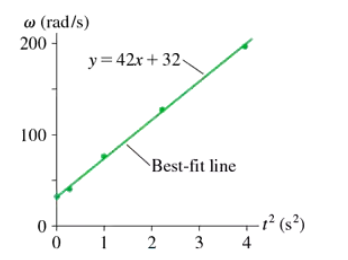
The angular velocity of a spinning gyroscope is measured every 0.5 s. The results and the best-fit line from a spreadsheet are shown in FIGURE P4.63. What is the gyroscope's initial angular velocity at t = 0 s?

Verified step by step guidance
1
Step 1: Analyze the graph provided. The graph shows the angular velocity (ω) in rad/s plotted against the square of time (t²) in seconds squared. The best-fit line is given as y = 20x + 10, where y represents ω and x represents t².
Step 2: Identify the initial condition. The problem asks for the gyroscope's initial angular velocity at t = 0 s. When t = 0 s, the square of time (t²) is also 0.
Step 3: Substitute t² = 0 into the equation of the best-fit line, y = 20x + 10. Replace x with 0, as x represents t².
Step 4: Perform the substitution: ω = 20(0) + 10. This simplifies to ω = 10 rad/s.
Step 5: Conclude that the gyroscope's initial angular velocity, at t = 0 s, is determined by the y-intercept of the best-fit line, which is 10 rad/s.

Verified video answer for a similar problem:

This video solution was recommended by our tutors as helpful for the problem above.
Video duration:
4m
Was this helpful?

Key Concepts

Here are the essential concepts you must grasp in order to answer the question correctly.

Angular Velocity

Angular velocity is a measure of how quickly an object rotates around an axis, typically expressed in radians per second (rad/s). It indicates the rate of change of angular displacement over time. In the context of a gyroscope, it reflects how fast the gyroscope is spinning, which is crucial for understanding its motion and stability.
Recommended video:
Guided course
06:18
Intro to Angular Momentum

Graph Interpretation

Interpreting graphs involves analyzing the relationship between variables represented on the axes. In this case, the graph plots angular velocity (ω) against the square of time (t²). The slope of the best-fit line indicates how angular velocity changes with time, and the y-intercept provides the initial angular velocity at t = 0 s, which is essential for answering the question.
Recommended video:
Guided course
07:32
Graphing Position, Velocity, and Acceleration Graphs

Linear Equation

The equation of the best-fit line, y = 20x + 10, represents a linear relationship between the variables. Here, 'y' corresponds to angular velocity, 'x' corresponds to time squared, and the coefficients indicate the slope and y-intercept. The y-intercept (10 rad/s) directly gives the initial angular velocity of the gyroscope at t = 0 s, which is critical for solving the problem.
Recommended video:
Guided course
07:31
Linear Thermal Expansion
Related Practice
Textbook Question

A cannonball is fired at 100 m/s from a barrel tilted upward at 25°. What is the angle after the cannonball travels 500 m?

1291
views
Textbook Question

Ships A and B leave port together. For the next two hours, ship A travels at 20 mph in a direction 30° west of north while ship B travels 20° east of north at 25 mph. What is the speed of ship A as seen by ship B?

1005
views
Textbook Question

While driving north at 25 m/s during a rainstorm you notice that the rain makes an angle of 38° with the vertical. While driving back home moments later at the same speed but in the opposite direction, you see that the rain is falling straight down. From these observations, determine the speed and angle of the raindrops relative to the ground.

1175
views
Textbook Question

A ball rolling on a circular track, starting from rest, has angular acceleration α\alpha. Find an expression, in terms of α\alpha, for the time at which the ball's acceleration vector a is 4545^{\circ} away from a radial line toward the center of the circle.

810
views
Textbook Question

A typical laboratory centrifuge rotates at 4000 rpm. Test tubes have to be placed into a centrifuge very carefully because of the very large accelerations. What is the acceleration at the end of a test tube that is 10 cm from the axis of rotation?

1099
views
1
rank
Textbook Question

A typical laboratory centrifuge rotates at 4000 rpm. Test tubes have to be placed into a centrifuge very carefully because of the very large accelerations. For comparison, what is the magnitude of the acceleration a test tube would experience if dropped from a height of 1.0 m and stopped in a 1.0-ms-long encounter with a hard floor?

622
views