
A long, thin rod of mass M and length L is standing straight up on a table. Its lower end rotates on a frictionless pivot. A very slight push causes the rod to fall over. As it hits the table, what are the speed of the tip of the rod?
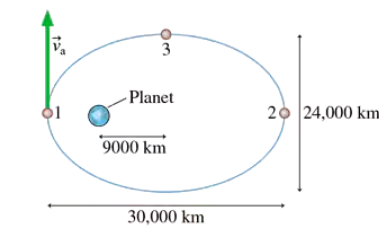
A satellite follows the elliptical orbit shown in FIGURE P12.77. The only force on the satellite is the gravitational attraction of the planet. The satellite's speed at point 1 is 8000 m/s. What is the satellite's speed at point 2?

Verified step by step guidance
Verified video answer for a similar problem:
Key Concepts
Gravitational Force
Conservation of Energy
Elliptical Orbits
The sphere of mass M and radius R in FIGURE P12.75 is rigidly attached to a thin rod of radius r that passes through the sphere at distance (1/2)R from the center. A string wrapped around the rod pulls with tension T. Find an expression for the sphere's angular acceleration. The rod's moment of inertia is negligible.
A satellite follows the elliptical orbit shown in FIGURE P12.77. The only force on the satellite is the gravitational attraction of the planet. The satellite's speed at point 1 is 8000 m/s. Does the satellite experience any torque about the center of the planet? Explain.
A 10 g bullet traveling at 400 m/s strikes a 10 kg, 1.0-m-wide door at the edge opposite the hinge. The bullet embeds itself in the door, causing the door to swing open. What is the angular velocity of the door just after impact?
A merry-go-round is a common piece of playground equipment. A 3.0-m-diameter merry-go-round with a mass of 250 kg is spinning at 20 rpm. John runs tangent to the merry-go-round at 5.0 m/s, in the same direction that it is turning, and jumps onto the outer edge. John's mass is 30 kg. What is the merry-go-round's angular velocity, in rpm, after John jumps on?
FIGURE P12.82 shows a cube of mass m sliding without friction at speed v0. It undergoes a perfectly elastic collision with the bottom tip of a rod of length d and mass M = 2m. The rod is pivoted about a frictionless axle through its center, and initially it hangs straight down and is at rest. What is the cube's velocity—both speed and direction—after the collision?
