
Textbook Question
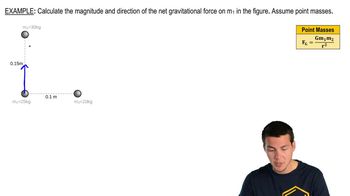
What is the total gravitational potential energy of the three masses in FIGURE P13.35?
1886
views

 Verified step by step guidance
 08:36
08:36
 05:41
05:41 9:26
9:26What is the total gravitational potential energy of the three masses in FIGURE P13.35?
A new planet is discovered orbiting the star Vega in a circular orbit. The planet takes 55 earth years to complete one orbit around the star. Vega's mass is 2.1 times the sun's mass. What is the radius of the planet's orbit? Give your answer as a multiple of the radius of the earth's orbit.
What is the net gravitational force on the 20.0 kg mass in FIGURE P13.36? Give your answer using unit vectors.
The Parker Solar Probe, launched in 2018, was the first spacecraft to explore the solar corona, the hot gases and flares that extend outward from the solar surface. The probe is in a highly elliptical orbit that, using the gravity of Venus, will be nudged ever closer to the sun until, in 2025, it reaches a closest approach of 6.9 million kilometers from the center of the sun. Its maximum speed as it whips through the corona will be 192 km/s. The probe's highly elliptical orbit carries it out to a maximum distance of 160 Rs with a period of 88 days. What is its slowest speed, in km/s?
What is the total gravitational potential energy of the three masses in FIGURE P13.36?
A small moon orbits its planet in a circular orbit at a speed of 7.5 km/s. It takes 28 hours to complete one full orbit. What is the mass of the planet?